
Dynamics 365 vs. NetSuite

Dynamics 365 vs. NetSuite

Comparing the two cloud ERPs

When comparing Dynamics 365 and NetSuite, think about the future

We often work with organizations that are evaluating NetSuite and Dynamics 365. While on the surface, both seem comparable in terms of capabilities, business functions, and infrastructure, there are some important distinctions. 

At Sunrise, we help growing businesses evaluate these platforms through the lens of future scalability, integration flexibility, and operational complexity. Whether your focus is on tightening your financial management, improving supply chain efficiency, or driving operational resilience, this article will guide you through a practical comparison of NetSuite and Dynamics 365 Finance and Operations—so you can choose the ERP that grows with your business.

Dynamics 365 Overview

Dynamics 365 is a suite of applications that unifies processes across finance, supply chain, commerce, and customer service on a single platform. Its integration with other Microsoft products, such as Office 365 and Azure, provides a seamless experience for users familiar with the Microsoft ecosystem.

Built to support growing businesses, Dynamics 365 offers modular applications that can be implemented individually or together, allowing organizations to start with what they need and scale at their own pace. With built-in AI capabilities like Microsoft Copilot, businesses gain intelligent insights, improve decision-making, and automate repetitive tasks. Additionally, its low-code/no-code tools, such as Power Apps and Power Automate make customization accessible even without deep technical expertise.

Whether it’s optimizing financial operations, managing complex supply chains, or improving customer experiences, Dynamics 365 delivers a connected and flexible solution for modern enterprises.

NetSuite Overview

NetSuite provides foundational inventory management capabilities, including demand planning, automated replenishment, and basic warehouse tracking. Its Saved Searches and customizable dashboards offer valuable visibility, making it well-suited for businesses with simple product catalogs and straightforward inventory requirements.

However, companies that require more sophisticated features—such as real-time serialization, complex global inventory coordination, or support for multi-dimensional SKUs—may find NetSuite’s functionality limited in those areas.

Comparison table: NetSuite vs. Dynamics 365 Finance and Supply Chain

Below is a detailed comparison of the two systems:

Feature CategoryNetSuiteMicrosoft Dynamics 365
Merchandising & inventory managementNetSuite offers essential tools for managing inventory across locations, including demand planning, replenishment automation, and basic warehouse tracking. Its saved searches and customizable dashboards provide useful insights, making it a strong fit for companies with relatively straightforward product catalogs and inventory needs. While NetSuite covers these functions, it may fall short for businesses needing advanced capabilities like real-time serialization, global inventory coordination, or multidimensional SKU management.

Dynamics 365 excels in complex supply chain environments, offering multi-level product hierarchies, serial and batch tracking, and AI-driven demand forecasting. Its tight integration with warehouse automation systems, barcode scanning, and mobile inventory workflows make it ideal for manufacturers, distributors, and global retailers.

Dynamics 365 Supply Chain Management also supports cross-border inventory tracking, landed cost calculations, and real-time visibility across warehouses, empowering companies to enhance logistics performance and reduce stockouts or overstock situations.

Point of Sale (POS)NetSuite includes a native POS module and solid eCommerce functionality that works well for retail environments with modest channel complexity. It enables centralized data for sales, inventory, and customer transactions but often requires third-party tools or add-ons for a true omnichannel experience. While suitable for B2C brands with straightforward processes, NetSuite can be limiting for businesses that demand real-time store operations, complex promotions, or B2B commerce coordination across multiple regions.Pairing Microsoft Dynamics Finance and Supply Chain with Commerce delivers a powerful, end-to-end omnichannel solution. From in-store POS and mobile checkout to digital storefronts and marketplace integrations, the platform offers a single source of truth across every touchpoint. Built-in tools enable real-time customer insights, synchronized inventory, and dynamic pricing—empowering companies to elevate service and drive loyalty. The deep integration with other Dynamics 365 ecosystem apps like Customer Insights, Power BI, and Microsoft Teams enhances collaboration and personalization.
Financial managementNetSuite provides robust out-of-the-box finance and accounting functionality, including general ledger, accounts receivable/payable, bank reconciliation, and basic financial analysis tools. Its SuiteBilling module supports subscription-based models, making it ideal for SaaS and services businesses. However, its capabilities can feel limited for organizations with complex reporting structures, intercompany transactions, or compliance needs tied to GAAP or IFRS standards.

Dynamics 365 is built for global organizations with multidimensional and complex accounting needs. With features like multi-entity accounting, real-time budgeting, fixed asset tracking, subscription billing, cost accounting, and automated revenue recognition, Dynamics 365 Finance supports the needs of both finance teams and auditors.

The app’s native support for local tax regulations, multi-currency consolidation, and project-based accounting makes it particularly attractive for global firms. Additionally, embedded Power BI dashboards and Microsoft Copilot enable predictive insights and scenario modeling to help finance leaders stay ahead.

Omnichannel capabilitiesProvides omnichannel support through its SuiteCommerce platform, which connects eCommerce, in-store POS, and order management systems. While it offers essential capabilities like real-time inventory tracking and customer data unification, delivering a fully integrated omnichannel experience may require additional setup, third-party tools, or custom development.Supports omnichannel retailing through Dynamics 365 Commerce, allowing for cohesive customer experiences across online and offline channels. Features include unified customer profiles, cross-channel loyalty programs, and seamless order fulfillment processes.
Customization & integration

NetSuite promotes a “clicks not code” approach to customization. Using SuiteBuilder and SuiteCloud, users can configure fields, workflows, and dashboards with relative ease. Developers can extend functionality using SuiteScript, a JavaScript-based scripting language, and REST or SOAP APIs for system integration.

This low-code environment works well for companies with lighter customization needs, but limitations emerge when building deeply integrated, cross-platform business processes—especially those spanning CRM, finance, supply chain, and analytics.

Dynamics 365 F&O stands out with its tight integration into the Microsoft Power Platform. Using Power Automate, Power Apps, and Azure Logic Apps, businesses can build custom workflows, automate approvals, and connect F&O to virtually any system—without heavy development overhead.

Additionally, Microsoft’s Dataverse provides a unified data layer across Dynamics applications, making integration with Microsoft 365, Power BI, and Teams seamless. AI-driven recommendations through Copilot enhance productivity by suggesting smart workflows based on user behavior and context.

User experience & interfaceOffers a functional, dashboard-driven interface with strong data visibility. However, the UI can feel dated and less intuitive, often requiring more training or technical input.Features a modern interface consistent with other Microsoft products like Office 365, providing a familiar environment for users. The system offers customizable dashboards, workspaces, and a responsive design, enhancing user engagement across
Scalability & deploymentNetSuite is offered as a single-tier, multi-tenant SaaS solution, making deployment fast and upgrades automatic. This model is ideal for businesses seeking a streamlined path to ERP adoption without dedicating large IT resources.Dynamics 365 F&O provides enterprise-class scalability through modular licensing, regional Azure deployments, and flexible infrastructure configurations. Businesses can adopt what they need today—finance, supply chain, commerce—and scale into manufacturing, HR, or advanced analytics later.
Licensing & costsIts pricing includes bundled modules, which helps simplify procurement. However, that simplicity can lead to long-term trade-offs: limited control over upgrade timing, reliance on third-party solutions for industry-specific needs, and potential functional ceilings as business processes mature.The ability to control upgrade timing and deploy in specific geographies (for compliance or latency reasons) makes it highly attractive to global and multi-entity organizations. While initial licensing may seem higher, many businesses find the total cost of ownership (TCO) favorable over time due to fewer workarounds and more built-in functionality.
Customer supportOffers tiered support plans, but advanced support often comes at a premium. While resources like the NetSuite Help Center and SuiteAnswers are available, users frequently rely on third-party consultants for in-depth support and system customization—something more streamlined in the Dynamics 365 partner ecosystem.Microsoft offers Standard, Premier, and Unified Support. Some Microsoft Partners offer ongoing support programs, from handling maintenance and upgrades to implementing new modules and capabilities.

What about AI capabilities in Dynamics 365 vs. NetSuite?

Dynamics 365 is ahead of the curve when it comes to built-in AI. With the introduction of Microsoft Copilot, Dynamics 365 brings conversational AI and generative insights directly into ERP and CRM workflows. Users can automate tasks like invoice creation, email drafting, and report generation using natural language. Additionally, its deep integration with the Microsoft Power Platform (Power BI, Power Automate, Power Apps) allows users to build AI-powered dashboards, automate decision trees, and analyze trends using predictive analytics — all without heavy coding.

Microsoft’s ecosystem advantage plays a big role here: businesses using Teams, Outlook, or SharePoint can experience AI-enhanced workflows across systems, making Dynamics 365 a very intelligent and connected solution out-of-the-box.

NetSuite, while good in automation and reporting, is still catching up in AI features. It does offer machine learning in some areas like cash flow forecasting, demand planning, and anomaly detection, primarily through its SuiteAnalytics and SuitePeople modules. However, much of the advanced AI functionality often requires integration with third-party tools or custom development.

Oracle has introduced AI innovations across its broader cloud ecosystem, and these features are gradually surfacing in NetSuite, but the experience isn’t as deeply embedded or accessible yet compared to Dynamics 365.

The bottom line? You might outgrow NetSuite, too

…and end up right back where you started, looking for a replacement ERP system. NetSuite is a strong contender for businesses looking for rapid deployment, foundational financial management, and streamlining operations across a limited number of entities. For organizations with standard workflows and modest customization needs, NetSuite is a compelling starter cloud ERP.

However, for companies navigating global operations, complex supply chains, advanced warehousing and logistics needs, and long-term scalability, Dynamics 365 Finance and Supply Chain is the clear winner.

  • Advanced planning capabilities: Embedded demand forecasting, MRP, and AI-driven insights enable smarter supply chain decisions.

  • AI roadmap: Microsoft Copilot delivers real-time, embedded AI across finance, operations, and customer engagement modules, no integrations required.

  • Power Platform: Build custom apps, workflows, and automation with low-code tools like Power Apps and Power Automate, fully integrated with your ERP.

  • Seamless omnichannel capabilities: Unify in-store, online, and back-office operations with Dynamics 365 Commerce for consistent customer experiences.

  • Modern, intuitive UI: A user-friendly, Microsoft-aligned interface that reduces training time and boosts adoption.

  • Automatic updates & innovation: Benefit from continuous improvements and feature rollouts without disruption.

  • Microsoft ecosystem integration: Deep, native connectivity with Teams, Outlook, Excel, Azure, and more, enabling truly unified business operations.

When your business demands more than the basics, Dynamics 365 isn’t just the next step; it’s the strategic upgrade.

Frequently asked questions

NetSuite is a cloud-based ERP designed for mid-sized businesses with simpler processes, while Microsoft Dynamics 365 offers a modular, enterprise-grade ERP and CRM suite built for scalability, complex operations, and deep integration with the Microsoft ecosystem.

Yes. Dynamics 365 allows businesses to start with core modules and expand to areas like HR, manufacturing, and advanced analytics as they grow. It supports complex configurations and global rollouts, making it ideal for scaling.

NetSuite covers basic supply chain needs but lacks the deep features of Dynamics 365, such as AI-driven forecasting, landed cost calculations, and real-time visibility across global warehouses.

Dynamics 365 offers advanced financial tools including multi-entity accounting, cost tracking, subscription billing, and GAAP/IFRS compliance. NetSuite is strong in core finance but may fall short for complex reporting or compliance needs.

Both support these features, but Dynamics 365 handles them more comprehensively, with built-in consolidation, intercompany processing, and compliance tools.

Dynamics 365 excels in this area with embedded Power BI and native compliance tools. NetSuite handles standard reporting well but may require additional tools or services for advanced needs.

Dynamics 365 is preferred for manufacturing due to its support for MRP, BOMs, shop floor control, and integration with warehouse systems. NetSuite offers manufacturing features but is less robust.

Yes. Dynamics 365 uses AI for demand forecasting and planning. NetSuite includes demand planning but lacks predictive AI-driven insights.

Dynamics 365 offers a modern, Office-like interface with customizable dashboards and workspaces. NetSuite’s interface is functional but may feel dated and require more training.

Dynamics 365 leads in embedded AI with Copilot, enabling task automation, insights, and predictive analytics. NetSuite has some machine learning features but is still evolving in AI.

Dynamics 365 may have a higher upfront cost, but its total cost of ownership (TCO) can be lower due to fewer third-party tools and broader built-in features.

NetSuite offers tiered support, with advanced help often costing more. Microsoft provides Standard, Premier, and Unified support, with partner-led programs offering personalized service.

Dynamics 365 benefits from Microsoft’s global partner network and a strong ecosystem. NetSuite has certified partners too, but some users rely more on third-party consultants.

Yes. Many businesses migrate from NetSuite to Dynamics 365 as their operational complexity increases. Migration involves data mapping, platform configuration, and training.

Dynamics 365 is considered more future-proof due to embedded AI, Microsoft integration, modular design, and continuous innovation through the Microsoft Cloud roadmap.

Dynamics 365 is Your Forever System

If you’re deciding between Dynamics 365 and NetSuite, now is the time to explore your options. A smooth migration to Dynamics 365 can future-proof your business, reduce costs, and improve efficiency. Contact us today for a free assessment. Our experts will help you map out a cost-effective path forward and give you a blueprint for a successful ERP project.

Dynamics 365 license management & cleanup guide

Dynamics 365 License Management

Use this license cleanup guide to prepare for changes to Dynamics 365 license enforcement

Microsoft is introducing new tools to monitor and manage D365 licenses

Microsoft is cracking down on Dynamics 365 license enforcement. New tools and reports promise to make managing users easier, but on January 15, 2026, users who haven’t been assigned a license will lose access to their Finance and Operations production environments.

Don’t get caught by surprise! Below is a step-by-step guide on how to reconcile system users with your current licenses and subscriptions, assign named users to licenses, and ensure you’re compliant with Microsoft’s requirements.

Key dates to remember

September 1, 2025

  • Users who haven’t been assigned a license will see a notification when they log in to Dynamics 365 Finance & Operations, prompting them to contact their administrator.

November 1, 2025

  • Users who haven’t been assigned a license will lose access to their Dynamics 365 Finance & Operations production environments.

Part 1. Log in to Power Platform Admin Center (PPAC) license reporting

Find your current license utilization report here:

  1. Go to https://admin.powerplatform.microsoft.com.
  2. Make sure to toggle on the “New Admin center” look in the upper right-hand corner.
  3. Go to Licensing > Finance and Operations. By default, the form filters to your production environment.
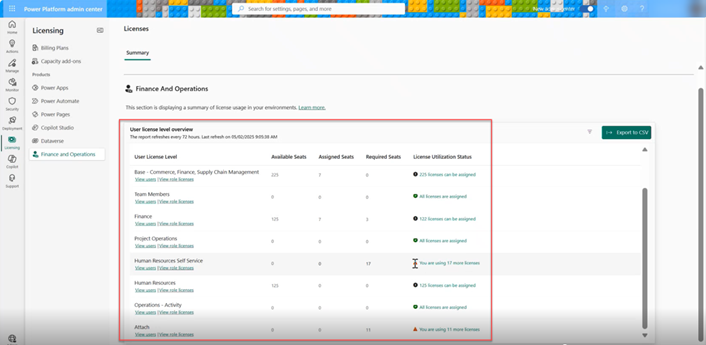
  4. Screenshot the page for easy reference. You should have a report that looks like this:
    A screenshot of the licenses summary page in Power Platform Admin Center (PPAC), showing an overview of user licenses in Finance and Operations.
  5. Look at the License Utilization Status column and refer to the chart below for what to do for each scenario:
ScenarioWhat it meansNext action
No Issues:


Available Seats ≥ Required Seats and all are Assigned

Utilization Status: “All licenses are assigned.”

You’re good to go! All available seats cover your user requirements, and every user has been assigned a license.No action required. Consider reducing your total licenses if excess capacity exists.
Fully licensed but need assignments:


Available Seats ≥ Required seats, but are not fully assigned

Utilization Status: “X licenses can be assigned.”

Sufficient licenses exist, but some users haven’t been assigned a license.Assign licenses to unlicensed users.
Under licensed:


Available Seats < Required Seats

Utilization Status: “You are using X more licenses.”

More users are triggering license requirements than you have seats for.Perform an audit: review security roles, reduce permissions or duties, or determine if more licenses are needed. Then assign licenses to users.

Note about Device licenses:

Device licenses and usage are not included in the PPAC license report. We recommend that you manually track physical device usage (such as warehouse scanners and POS terminals) and ensure purchased quantities match your needs.

What to do if you are under-licensed

Time for a true-up!

Export the PPAC license report to CSV for use in detailed analysis:

  • In the top right of the overview section, click Export to CSV.
  • The Download license information slider pop-up will appear. Click Start to generate the file and download.
  • This report will show all users and the associated license types being triggered as required.

Create a separate master list of all expected current F&O users:

  • To compare against the PPAC report, you’ll need to create a table of your current F&O users if you haven’t already. Exporting your F&O security roles can give you a base list to start. We recommend you include the following:
    • Email or user ID
    • Plain language job title and description (e.g., “Accounts Payable Clerk”)
    • Your expected license type for each user (Team Member, Operations Activity, Base Supply Chain, Base Finance, etc.)

Now you can compare the two lists:

  • Flag any specific users or roles that appear to be incorrectly assigned a higher-than-expected license.
    • For example, you might find a read-only user that shows up as requiring a full Base or Activity license. This is important because you will later investigate what F&O permissions are triggering the unnecessarily higher license.

Now that you’ve exported the PPAC license report and compared it against your list, it’s time to analyze user role permissions in Dynamics 365 Finance & Operations.

Part 2. Dynamics 365 license cleanup and reconciliation process

1. Analyze role permissions in F&O

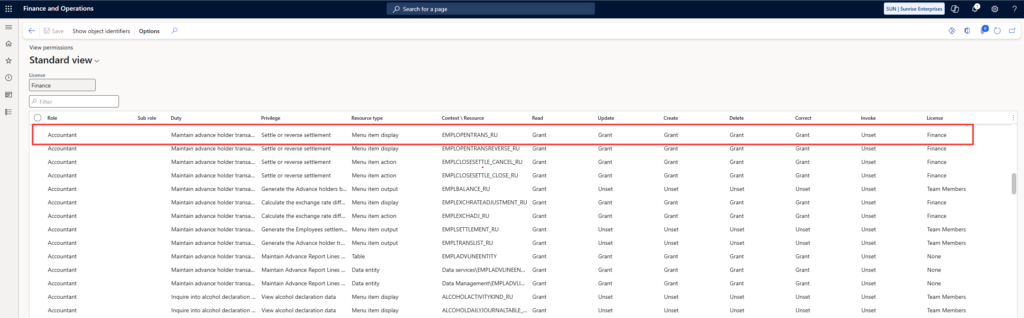
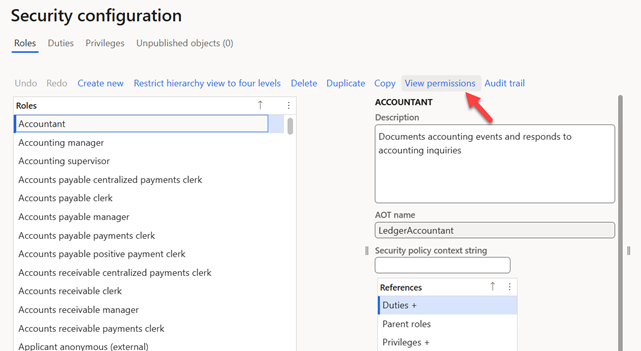
In Finance & Operations, go to System Administration > Security Configuration. Select the user role in question, click “View Permissions” and review Duties/Privileges that are contributing to the license tier:

A screenshot of the Security configuration-Roles page in Dynamics 365 Finance and Operations.

A screenshot of Finance and Operations, showing the user permissions for an Accountant role.

2. Optimize custom roles

If using custom roles, consider duplicating and modifying them to remove non-essential privileges or duties. Ensure the new role supports business needs while minimizing license impact.

3. Submit licensing disputes

If specific privileges are still triggering higher licenses and you believe they shouldn’t, document them and escalate with your partner and/or Microsoft.

Types of Dynamics 365 licenses

Below is a simplified summary of the different Dynamics 365 F&O user-based license types. For the full description of each license, refer to the latest edition of the Microsoft Dynamics 365 licensing guide: link

(Note: the above is a link to the May 2025 licensing guide. To find the latest Dynamics 365 licensing guide at any time, visit the Microsoft resource site: Licensing Documents.

License TypeDescription
Team MemberMostly read-only users. Can view data and reports. Limited transactional rights.
Activity

Approvers, warehouse, or shop floor users who interact via shared terminals or perform confirmations. Depending on access requirements, Activity license holders can also include customer service and order entry personnel.

Operations–Activity users generally are allowed to:

  • Create and edit items related to
    • Orders (sales and purchase orders)
    • Vendor maintenance
    • Warehousing (receiving and shipping)
    • Budgets
  • Record and approve:
  • Operate POS devices (depending on their role and if licensed accordingly)

Examples of allowed tasks:

  • Entering or editing sales or purchase orders
  • Modifying basic vendor or inventory details associated with an order
  • Participating in approval workflows related to order entries (within their permission scope)
  • Updating order line items under specific constraints
BaseFull or transactional access. Includes finance, inventory, or production responsibilities. Attach-type licenses are required when using multiple Base functionality areas (e.g., Finance, Supply Chain, Commerce, Project Operations, etc.).

Tips for managing your Dynamics 356 licenses

We have found the following simple tips greatly helpful:

  • Create one parent role per user job type, where possible, to simplify future license analysis.
  • Use naming conventions for custom roles that reflect the job title or team.
  • Perform all edits in a sandbox environment first, then promote to production.

Part 3. Ongoing maintenance: Review Dynamics licensing assignments in Power Platform Admin Center

Starting in 2025, Microsoft requires that all D365 Finance & Operations users be explicitly assigned a license through the Power Platform Admin Center. This ensures correct access and avoids unexpected license errors. To look up users that need to be assigned a license, follow these steps:

1. Go to https://admin.powerplatform.microsoft.com
2. Make sure to toggle on the “New Admin center” look in the upper right-hand corner.
3. Go to Licensing > Finance and Operations. By default, the form auto-filters to the production environment.
4. Review the list of users to identify those who are unassigned or incorrectly assigned.
5. To assign users, continue to the next step.

Part 4. Assign users to licenses in Microsoft 365 Admin Center

If you identify a user or group in PPAC that needs a license assigned, you’ll make the assignment in the Microsoft 365 Admin Center. Here’s how:

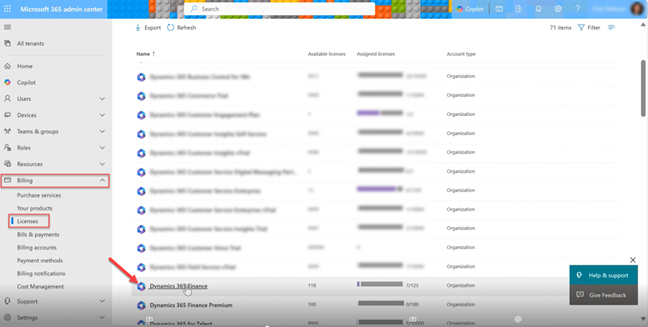
1. Go to the Microsoft 365 Admin Center (https://admin.microsoft.com> Billing > Licenses.
2. Select the desired license name, such as Dynamics 365 Finance.
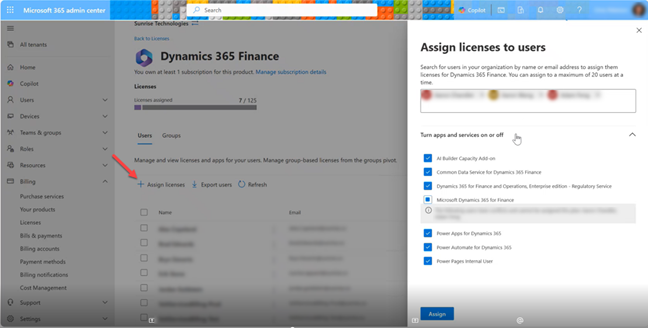
3. Select Assign licenses > add the desired user(s) to assign > click Assign.

Tip: You may want to create and then assign Entra groups for sets of users requiring the same license type.

A screenshot of the Microsoft 365 Admin Center, where users can be assigned Dynamics 365 licenses.

A screenshot of the Microsoft 365 Admin Center and screen where you assign licenses to users,

Frequently asked questions

Yes, we have seen recent inaccuracy issues with reporting in PPAC as Microsoft releases new features. The Microsoft product team is actively working on resolutions.

Microsoft is refining and restructuring PPAC and making significant changes to its layout and functionality. In the future, PPAC will be a centralized hub for managing both licenses and environments.

In the meantime, it’s critical to assign licenses to users. We recommend you independently track your expected user counts, actual system users, and assigned security roles to establish a reliable baseline to compare against PPAC’s data.

It’s important to independently track your expected user counts, actual system users, and assigned security roles to establish your license baseline for comparison against PPAC’s reports. This blog post contains detailed instructions for comparing your license actuals against what’s in PPAC. Here’s a summary of the process:

  • Create a master list of all current Dynamics users.
  • Clean up current licenses: Assign purchased licenses to your users in the Microsoft 365 Admin Center and delete expired users from the system.
  • Export the report of Dynamics users from PPAC (note: this report only refreshes every 72 hours).
  • Compare your expected users versus the list in PPAC.
  • Note and investigate any discrepancies.
  • Analyze security roles and role permissions in F&O to identify any permissions that may trigger a higher-level license (i.e., Base license versus Activity license).
  • Adjust permissions in each role as needed.
  • Re-run the PPAC report. Note: License assignments take place in real time in Microsoft 365 but it takes 72 hours for changes to be reflected in the PPAC report.

Microsoft has not yet released formal guidance on how it will check for compliance. However, at this point we recommend assuming that license validation will occur at the license type level. This is signaled by the PPAC report, which audits expected user counts by license type and outlines the number of users required per license category.

Microsoft is introducing significant enhancements to security governance in Dynamics 365 Finance and Operations, aiming to provide administrators with more robust tools for managing user roles, ensuring compliance, and optimizing licensing. These are currently in preview and expected to be released in July 2025 (Dynamics version 10.0.44). These features will greatly speed up security role creation, analysis, and adjustments.

As it specifically relates to licensing:

Microsoft 365 Admin Center:

  • Used for all licensing assignments.
  • View available licenses vs. assigned licenses.

Power Platform Admin Center (PPAC):

  • View F&O license utilization status. PPAC shows not only your available and assigned licenses, but also required licenses and suggested actions.
    • Don’t forget: Reports refresh once every 72 hours.
  • Download detailed user/role/license information.
  • View storage utilization status.

Lifecycle Services (LCS):

  • Features will be released to show license reporting from PPAC. This feature is being added to LCS because Microsoft understands that F&O customers and partners often use LCS, whereas PPAC access is often more restricted.
  • Note that in time, LCS is planned for deprecation.

Get a free license mapping assessment

Contact us to speak with a licensing expert today. We can help you prepare for Microsoft’s upcoming license enforcement changes and optimize costs.

What is Quick Migrate? An overview of our data migration tool

What is Quick Migrate?

An overview of our data migration tool

Accelerate Your Data Migration with Confidence

Sunrise QuickMigrate is the fastest and most reliable way to migrate legacy data to Microsoft Dynamics 365 Finance and Operations (D365 F&O). Built on Azure Data Factory and Power BI, QuickMigrate automates, validates, and accelerates your entire D365 data migration process—reducing project risks and saving hundreds of hours. Whether you’re planning a large-scale implementation or preparing for a go-live, QuickMigrate ensures your data migration is efficient, accurate, and stress-free.

Why Automate Your Dynamics 365 Data Migration?

Migrating data into D365 F&O is one of the most critical—and challenging—parts of any ERP project. QuickMigrate eliminates common data migration pain points:

  • Automated Data Extraction, Transformation, and Loading: Replace error-prone manual file handling with Azure Data Factory pipelines that automate the ETL process for Dynamics 365 migrations.
  • Built-In Data Validation and Comparison: Use integrated Power BI dashboards to verify data accuracy between legacy systems and D365 F&O at every migration cycle.
  • Simplified Error Management: Centralized dashboards make it easy to find, fix, and reprocess data errors without digging through D365’s Data Management workspace.
  • Faster Iterative Migration Cycles: Quickly manage multiple environments (Dev, UAT, Prod) and run migration cycles for CRPs, SITs, and Go-Lives with full tracking and reporting.
  • Self-Service Flexibility: Hosted in your Azure subscription, QuickMigrate empowers both consultants and client teams to manage migrations independently.

How Sunrise QuickMigrate Works

QuickMigrate automates every major phase of a Dynamics 365 Finance and Operations data migration:

  1. Extract and Transform Data: Pull data from legacy ERP systems, clean and transform it using pre-defined Azure Data Factory pipelines.
  2. Load into D365 F&O: Automatically create and run D365 Data Management projects to load master and transactional data.
  3. Validate Data Accuracy: Export data post-load, then run source-to-target comparison with visual insights from Power BI dashboards.
  4. Iterate Quickly: Manage multiple cycles seamlessly—from early CRPs to final go-live migrations—with change tracking and error resolution built in.

Work with an ERP Partner that Knows Your Industry

Planning an ERP project? Reach out to schedule a call with us today. We work with companies of all sizes to modernize their operations on a single platform—Dynamics 365.

Dynamics 365 licensing guide

Dynamics 365 Licensing Guide

Check out the latest edition of the Dynamics 365 licensing guide, released in May 2026. It’s a comprehensive resource for understanding how Microsoft licenses its suite of business applications across finance, operations, sales, customer service, and more. This educational guide explains the types of licenses available—user, device, and tenant—and outlines the latest pricing, purchase channels, capacity entitlements, and use rights. Whether you’re evaluating Dynamics 365 for the first time or expanding your current deployment, this guide will help you make informed decisions, avoid costly licensing mistakes, and align your investment with actual usage.


Do you have questions about your specific situation? Our experts can help you map out the most cost-effective way to license Dynamics 365 for your organization. Contact us for a free assessment and licensing blueprint.

Start Your Journey with Sunrise Today!

Whether you’re exploring your options for new business platforms, or ready to get started, we are trusted business partners for some of the world’s most well-known brands. With over 25 years of experience with the Microsoft stack, we can help you understand all the capabilities Microsoft has to offer.

Dynamics 365 vs. Island Pacific

Island Pacific vs. Dynamics 365: A comparison

When on-premise systems reach end of life, retailers are often at a crossroads

What happens when your on-premise infrastructure reaches its end of life?

Retailers running Island Pacific ERP on-premise are no strangers to hardware deprecation announcements. While the ERP software itself will continue to be supported, IBM’s Power 9 servers—which many Island Pacific users rely on—will reach end of life on January 31, 2026. That leaves retailers with two choices:

  1. Invest in a costly, time-consuming server upgrade to keep running Island Pacific on-premise.
  2. Seize the opportunity to migrate to the cloud and modernize their ERP strategy.

For decades, the Island Pacific + IBM Power server combination was a strong choice for retail operations. However, the retail landscape has evolved significantly, and the capabilities that today’s businesses need—scalability, AI-driven analytics, omnichannel commerce, and real-time insights—are difficult (if not impossible) to achieve on aging, on-premise hardware.

Deprecation announcements like this aren’t just obstacles—they’re a chance to rethink the future. Instead of doubling down on legacy infrastructure, retailers can evaluate cloud-based ERP solutions like Microsoft Dynamics 365 to expand capabilities, enhance agility, and position themselves for future growth.

What hardware is approaching end-of-life for Island Pacific?

It’s important to note that support for the Island Pacific ERP system is NOT ending; support for IBM’s Power 9 servers, is ending on January 31, 2026. If you’re an Island Pacific user, you can keep using your ERP system on-premise by upgrading your servers, but that’s an expensive and time-consuming prospect.

Even though organizations in every industry face this same dilemma, this blog focuses on retailers in particular since we encounter this scenario often. Moving off legacy infrastructure and onto the cloud opens up a realm of possibilities for retailers to modernize their brands.

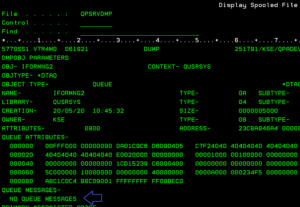
A picture of Island Pacific retail software on an old AS400 iSeries computer screen.

If your business systems look like this, it may be time for a change.

Island Pacific vs. Dynamics 365: Which is the better choice for retailers?

Island Pacific is a global leader in providing retail software solutions to help retailers manage and optimize their operations across multiple channels. The company’s flagship product, Island Pacific SmartSuite, offers a comprehensive suite of modules designed to streamline retail operations. These modules include merchandising, replenishment, financials, sales audit, warehousing, and ticketing functionalities.

Dynamics 365 is a suite of applications that unify processes across finance, supply chain, commerce, and customer service on a single platform. Its integration with other Microsoft products, such as Office 365 and Azure, provides a seamless experience for users familiar with the Microsoft ecosystem.

Feature CategoryIsland PacificMicrosoft Dynamics 365
Merchandising & inventory managementOffers a robust merchandising system through its SmartRetail module, enabling retailers to manage product assortments, pricing, promotions, and inventory across multiple channels. The system provides real-time visibility into stock levels, facilitating efficient inventory control.Provides comprehensive inventory management features within Dynamics 365 Supply Chain Management. Users can track inventory levels, manage procurement processes, and optimize warehouse operations. The system supports real-time analytics to forecast demand and adjust inventory accordingly. Partners also offer solutions to customize Supply Chain Management for retailers, with advanced inventory allocation capabilities.
Point of Sale (POS)Features the SmartStore module, which includes fixed and mobile POS solutions. These systems are designed to enhance in-store customer experiences by providing seamless transaction processing and integrating with back-end systems for real-time data synchronization.Offers POS capabilities through Dynamics 365 Commerce, enabling unified retail experiences across physical and digital channels. The system supports personalized customer engagements, centralized payment processing, and integrated inventory management.
Financial managementIncludes a Financials module that interfaces tightly with merchandising and warehouse functions, ensuring seamless invoice matching and financial reporting. Retailers can manage accounts payable, chart of accounts, and extract stock ledger data efficiently.Dynamics 365 Finance offers global financial management capabilities, including budgeting, costing, consolidation, and financial reporting. Its integration with Power BI allows for in-depth financial analytics and insights. AI and Copilot capabilities can help automate and streamline financial processes.
Omnichannel capabilitiesSmartOmni provides a centralized view of inventory across all channels, enabling retailers to offer flexible fulfillment options such as ship-from-store and click-and-collect. This ensures a consistent customer experience regardless of the purchasing platform.Supports omnichannel retailing through Dynamics 365 Commerce, allowing for cohesive customer experiences across online and offline channels. Features include unified customer profiles, cross-channel loyalty programs, and seamless order fulfillment processes.
Customization & integrationHighly flexible and modular system, allowing retailers to integrate third-party apps and customize solutions as needed. Retail-specific features work well within the platform but limited API support makes integrating with other tools difficult.Dynamics 365 apps have an extensibility model that lets you extend the built-in functionality to fit different requirements. More customization options are also available through the Microsoft Power Platform, allowing businesses to develop custom workflows. Dynamics 365’s native integration with other Microsoft services ensures a cohesive ecosystem for users.
User experience & interfaceEmphasizes a user-friendly interface with intuitive dashboards, enabling quick adoption by retail staff. The system’s design focuses on streamlining retail operations, reducing the learning curve for new users.Features a modern interface consistent with other Microsoft products like Office 365, providing a familiar environment for users. The system offers customizable dashboards, workspaces, and a responsive design, enhancing user engagement across
Scalability & deploymentOffers both on-premises and cloud-based solutions, allowing retailers to scale operations as their business grows. The modular nature of SmartSuite enables businesses to add functionalities incrementally.Primarily a cloud-based solution, it offers scalability to accommodate businesses of varying sizes. The platform’s architecture supports global operations, making it suitable for enterprises with expansive reach.
Licensing & costsPricing details are typically customized based on the specific modules selected and the scale of deployment.  Infrastructure for on-premises deployments can add significant costs.Operates on a subscription-based model, with pricing varying depending on the selected apps and user count. A Microsoft partner with retail industry experience can help you estimate your licensing and Azure subscription costs.
Customer supportPersonalized customer service is available for enterprise clients.Microsoft offers Standard, Premier, and Unified Support. Some Microsoft Partners offer ongoing support programs, from handling maintenance and upgrades to implementing new modules and capabilities.

The challenges of remaining on AS400

Retailers still running AS400 face mounting challenges as the platform ages. While AS400 has been a reliable mainstay for decades, the reality is that legacy hardware is costly to maintain, difficult to integrate with modern solutions, and increasingly reliant on a shrinking pool of IT professionals with the necessary expertise. Upgrading AS400 infrastructure often means investing in specialized hardware and custom development, making it an expensive and resource-intensive endeavor.

Comparing AS400 to Dynamics 365 isn’t a direct 1:1 comparison—AS400 is a hardware and operating system platform, while Dynamics 365 is a modern, cloud-based ERP system. However, the comparison is still valuable because it highlights what’s possible with a cloud-based approach. The major differences are highlighted below:

Technology & Architecture

FeatureAS/400 (IBM i)Microsoft Dynamics 365 ERP
PlatformOn-premises, IBM Power SystemsCloud-based (Azure), hybrid, or on-premises
DatabaseIBM Db2 for i (integrated)Microsoft Dataverse & Azure SQL
ProgrammingRPG, COBOL, CL, JavaModern languages (.NET, C#, JavaScript)
User InterfaceGreen screen (5250) or web-based GUIWeb-based, intuitive UI with Power Platform integration
IntegrationLimited API support, file-based exchangeOpen API, Power Platform, seamless Microsoft 365 integration

Functionality & Capabilities

FeatureAS/400 (IBM i)Microsoft Dynamics 365 ERP
ERP ScopeCustom-built or third-party ERP solutionsFull ERP suite (Finance, Supply Chain, Commerce, etc.)
AI & AutomationLimited capabilitiesBuilt-in AI (Copilot, predictive analytics)
Business IntelligenceBasic reporting, Excel exportsPower BI, embedded analytics
CustomizationHighly customized but complexLow-code/no-code customizations with Power Platform
ScalabilityScalable but hardware-dependentElastic scalability in the cloud

Security & Compliance

FeatureAS/400 (IBM i)Microsoft Dynamics 365 ERP
SecurityStrong, but older security modelsCloud-based, zero-trust security model
ComplianceIndustry-compliant but requires manual managementBuilt-in compliance (GDPR, SOX, HIPAA, etc.)
UpdatesManual software updates, patchesAutomatic cloud updates with regular enhancements

Costs & Maintenance

FeatureAS/400 (IBM i)Microsoft Dynamics 365 ERP
Total Cost of Ownership (TCO)High (hardware, licenses, maintenance)Lower TCO with cloud model (subscription-based)
IT MaintenanceRequires in-house AS/400 specialistsCloud-based, managed by Microsoft
Upgrade CostsCostly and complexContinuous updates included

Future-Proofing

FeatureAS/400 (IBM i)Microsoft Dynamics 365 ERP
Cloud AdoptionLimited, mostly on-premisesCloud-native, hybrid options available
Workforce ReadinessHard to find AS/400 specialistsWidespread adoption, easy hiring
InnovationIBM continues to support but limited innovationConstantly evolving with AI, IoT, automation

Evaluating your ERP options? Consider the future

Your organization’s infrastructure should be a growth enabler, not a limitation. As on-premise hardware reaches end-of-life, retailers face a critical decision: invest in costly infrastructure upgrades or embrace cloud solutions that drive innovation and efficiency.

Moving from Island Pacific ERP on-premise to Dynamics 365 isn’t just about avoiding outdated hardware—it’s about unlocking new capabilities that redefine how retailers operate:

  • Real-time, unified commerce – Seamless data integration across finance, supply chain, POS, and customer service.
  • AI-powered insights with Copilot – Embedded intelligence to enhance decision-making and automate workflows.
  • Cloud-based flexibility – Scale as needed, reduce IT overhead, and ensure business continuity.
  • Modern, intuitive UI – A familiar, user-friendly interface that boosts adoption and productivity.
  • Automatic updates & innovation – Stay ahead with continuous enhancements and an exciting feature roadmap.
  • Microsoft ecosystem integration – Work effortlessly with Office 365, Power BI, and other Microsoft solutions.
  • Low-code development with Power Platform – Empower teams to customize and extend functionality without heavy IT involvement.
  • Easier talent acquisition – Skilled professionals prefer working with modern systems, not legacy green screens.

Free Island Pacific Migration Assessment

If you’re still on Island Pacific, now is the time to explore your options. A smooth migration to Dynamics 365 can future-proof your retail business while reducing costs and improving efficiency. Contact us today for a free assessment. Our experts will help you map out a cost-effective path forward and give you a blueprint for a successful ERP project.
Accounting industry recognition

Accounting Industry Recognition

Sunrise Technologies is consistently recognized as a top Microsoft partner in the accounting and enterprise technology ecosystem.

Our inclusion in respected industry rankings affirms our leadership in delivering high-performance ERP and cloud solutions—especially for organizations with complex financial, operational, and industry-specific needs.

Over the years, Sunrise has been repeatedly recognized by leading publications and analysts, including:

Bob Scott’s VAR Stars

An exclusive group of value-added resellers selected based on factors such as growth, industry leadership, innovation, and recognition—not just revenue.
Being a VAR Star means Sunrise is consistently seen as a strategic, stable, and forward-thinking partner in the ERP space.

Accounting Today’s VAR 100

A list of the top 100 value-added resellers in the accounting software space, ranked annually based on performance, cloud adoption, and ability to serve mid-market and enterprise customers.
Sunrise has appeared on this list multiple times, reflecting our commitment to innovation and long-term customer value.

Aligned with Microsoft. Focused on Results.

As a long-standing Microsoft partner with deep ERP roots, Sunrise’s recognition by Accounting Today, Bob Scott, and others reflects our:

  • Global delivery model
  • Proven IP and implementation methodology

Commitment to customer success and long-term partnerships

Why It Matters

These industry endorsements validate more than technical expertise—they recognize the business outcomes we help our customers achieve:

  • Cloud ERP designed for financial complexity
  • Support for global consolidations, multi-entity rollups, and regulatory compliance
  • Industry IP that bridges finance and operations (e.g., Sunrise 365 Supply Chain + Financials)
  • Strong collaboration with CFOs, controllers, and IT leaders alike

Whether it’s helping clients modernize from legacy systems or optimizing reporting and controls in Dynamics 365, Sunrise has earned its place as a go-to partner in the accounting technology world.

Our work sits at the intersection of business strategy and digital transformation—backed by Microsoft’s technology, and proven by decades of customer trust.

Tackling a tough retail implementation?

Speak with one of our retail experts today.

Triad Fast 50 recognition

Triad Fast 50 Recognition

Sunrise Technologies has earned a place among North Carolina’s Piedmont Triad region’s most dynamic, fastest-growing private companies. The Triad Business Journal’s Fast 50 Awards celebrate businesses that show consistent growth, leadership, and innovation—qualities that have defined Sunrise since our founding.

To be eligible for this recognition, a company must have its U.S. headquarters in the Triad region, be privately held and for-profit, and have been in business for at least three full fiscal years.

This recognition is more than a number. It’s a reflection of our people, our customers, and the enduring impact of the solutions we deliver.

A Track Record of Sustained Growth

Sunrise Technologies has appeared on the Fast 50 list for 18 consecutive years—a rare achievement that speaks to the strength and stability of our business, even through changing economic climates and industry shifts.

Yearly Recognition

  • 2006: First appearance on the Fast 50 list
  • 2016: 10th consecutive year
  • 2024: 18th consecutive year
  • 2025:  19th consecutive year

From the first year we made the list to our most recent award, we’ve remained focused on delivering results, building trusted relationships, and continuously evolving our offerings with Microsoft.

What It Means to Us

“Fast 50 is a recognition of long-term performance, not just a moment of success. It’s about consistent execution, keeping our customers at the center, and being a company people want to work with—and for.”
— John Pence, Founder & Chairman, Sunrise Technologies

Highlights from the Past Year

Our continued growth in the past year reflected not just business momentum—but a deep commitment to innovation, customer success, and investing in the future.

  • 30th Anniversary: Celebrated three decades of business excellence and transformation leadership.
  • Launched Sunrise 365 Smart Supply Chain: A new solution to optimize global supply chain operations with real-time insights and AI-driven intelligence.
  • Innovated with Microsoft Copilot + AI: Invested heavily in learning, testing, and building Microsoft Copilot and AI capabilities to better serve our customers.
  • Growing Talent: Welcomed the newest class of recent graduates into our Fast Tracks early career program, building the next generation of Sunrise consultants.

These milestones represent more than product launches or headcount—they reflect our drive to stay ahead of what’s next and deliver meaningful value to our clients.

Celebrating the Journey

We’re proud to celebrate these milestones—not just for the accolades themselves, but for the stories they represent. From early-stage momentum to large-scale global partnerships, our growth is powered by strategic vision, innovation, and a deep alignment with Microsoft technologies.

This award isn’t just about revenue growth. It’s about delivering meaningful transformation for the brands we serve, building a world-class team, and staying committed to long-term excellence.

Tackling a tough retail implementation?

Speak with one of our retail experts today.

Microsoft Inner Circle recognition

Microsoft Inner Circle Recognition

Sunrise Technologies is proud to be a recurring member of the prestigious Microsoft Inner Circle, an exclusive group that represents the top 1% of Microsoft Business Applications partners worldwide. This recognition reflects our long-standing commitment to excellence, innovation, and strategic alignment with Microsoft.

A Global Standard of Excellence

To be named to the Inner Circle, Microsoft partners must consistently deliver outstanding customer outcomes, demonstrate deep industry expertise, and drive digital transformation through the Microsoft Cloud. Year after year, Sunrise has met and exceeded these standards. As a result, Sunrise has earned a seat at the Inner Circle table—participating in strategic summits and private briefings with Microsoft executives, shaping the future of Dynamics 365, Power Platform, and AI. Sunrise’s multi-year recognition spans over 15 years of strategic growth and alignment with Microsoft since 2009.

Why It Matters

Being part of Microsoft’s Inner Circle is about more than sales—it’s about trust, impact, and shared vision. Microsoft chooses partners who:
  • Deliver measurable value with Dynamics 365 and Power Platform
  • Invest in intellectual property, like our Sunrise 365 suite
  • Collaborate closely on AI innovation and Copilot integration
  • Drive digital transformation in retail, manufacturing, and distribution
This recognition highlights Sunrise as a strategic advisor, not just a systems integrator.

What Microsoft Says

“Partners achieving the Inner Circle distinction have demonstrated an exceptional impact helping customers accelerate their AI and digital transformation with Dynamics 365 and Power Platform, and we are honored to recognize this impact. Microsoft AI Cloud Partner Program partners who achieve the Business Application Inner Circle distinction stand out for their deep AI, Cloud, and Industry knowledge. They bring specialized IP, business process, and technical expertise to customers—and help them unlock incremental business value through services and solutions.” — Peter Jensen, Microsoft Business Application Partner Strategy Lead

What It Means to Sunrise

“Being selected for Microsoft’s Inner Circle is a tremendous honor. It reflects our team’s consistent execution and deep alignment with Microsoft’s goals. As we look to the future, I’m excited by what we’ll achieve together—especially in AI and next-gen transformation.” — John Pence, Founder & President, Sunrise Technologies

Looking Ahead

Sunrise continues to evolve alongside Microsoft—bringing together cloud, data, and AI to help customers achieve more. Inner Circle provides a unique opportunity to shape product strategy, influence innovation, and ensure our clients are at the forefront of what’s next.

Tackling a tough retail implementation?

Speak with one of our retail experts today.

Microsoft Partner of the Year awards and recognition

Microsoft Partner of the Year Awards and Recognition

Microsoft Partner of the Year Awards and Recognition

Sunrise Technologies is proud to be recognized by Microsoft as one of its most accomplished global partners—earning multiple Partner of the Year wins and finalist distinctions over the past decade. These awards honor our commitment to innovation, industry expertise, and consistent delivery of impactful Microsoft solutions for enterprise brands.

Consistently Among Microsoft’s Best

Microsoft’s Partner of the Year Awards are highly competitive, with thousands of nominations submitted annually by top-performing partners across more than 100 countries. These awards recognize excellence in customer implementation and innovation using Microsoft Business Applications—particularly Dynamics 365Power Platform, and the Microsoft Cloud. Sunrise has been honored multiple times, reflecting the trust Microsoft places in our ability to drive digital transformation at scale.

Why We Stand Out

These recognitions consistently highlight our:
  • Deep industry focus – Apparel, footwear, furnishings, retail, and distribution
  • Technical leadership – Dynamics 365 Finance, Supply Chain, Commerce, and Sales
  • Customer-centric execution – Especially during rapid industry shifts (e.g., e-commerce, omni-channel)
  • Microsoft alignment and IP investment – Including our proprietary Sunrise 365 solutions

Recognized Excellence Across Categories

Reverse date order, newest first

YearStatusAward Category
2023FinalistPartner of the Year – Dynamics 365 Supply Chain
2022WinnerPartner of the Year – Dynamics 365 Sales
2021FinalistRetail & Consumer Goods Partner of the Year
2021WinnerUS Partner of the Year – Dynamics 365 Commerce
2019WinnerGlobal Partner of the Year – Dynamics 365 Finance & Operations
2017FinalistMicrosoft Industry Partner of the Year
2015WinnerUS Microsoft Dynamics AX Retail Partner of the Year
2014WinnerUS Microsoft Dynamics AX Distribution Partner of the Year
2012FinalistMicrosoft Dynamics Distribution Industry Partner of the Year

What Microsoft Says

“These partners were outstanding among the exceptional pool of nominees, and I’m continuously impressed by their innovative use of Microsoft Cloud technologies and the impact for their customers.” — Nick Parker, CVP, Global Partner Solutions, Microsoft (2022) “It’s an honor to recognize winners and finalists… These companies are building intelligent solutions, addressing complex business challenges, and making more possible for customers around the world.” — Gavriella Schuster, CVP, One Commercial Partner, Microsoft (2019)

Why It Matters

Each award reaffirms our ability to:
  • Solve industry-specific challenges with real business solutions, not just technology
  • Lead enterprise transformation with ERP, CRM, and Supply Chain capabilities
  • Accelerate time-to-value with Sunrise 365 and tailored IP
  • Serve global brands through innovation, expertise, and execution
These honors reflect both the impact Sunrise delivers for customers and our strategic alignment with Microsoft’s ecosystem.

What It Means to Sunrise

“Winning these awards—especially at a global level—speaks to the strength of our team, our long-standing alignment with Microsoft, and our ability to deliver for our customers. We’re grateful for this recognition and excited for what’s ahead.”

— John Pence, Founder & President, Sunrise Technologies

Across more than a decade, Sunrise has consistently ranked among Microsoft’s top-performing partners—demonstrating strength in delivery, customer success, innovation, and co-sell collaboration.

Recognition Over the Years

In addition to Partner of the Year and Inner Circle honors, Sunrise has received several other standout awards and recognition designations throughout our long-standing partnership with Microsoft. While some of these programs are no longer active, they reflect the consistent performance, innovation, and strategic alignment that have defined our journey.

 Microsoft Solutions Partner

As of 2022, Sunrise transitioned from Microsoft Gold Competency status to the new Solutions Partner designations, meeting all enhanced performance, skilling, and customer success requirements.

This updated program reflects Microsoft’s commitment to deeper alignment with solution areas—validating Sunrise’s proven ability to deliver across Dynamics 365, Azure services, AI, Power Platform, and industry-specific innovation.

“We are on a mission to offer industry-specific solutions, and this builds on our ability to deliver global, omni-channel, Tier 1 supply chain capabilities—without all the cost and complexity.”
— John Pence, President, Sunrise Technologies

Microsoft President’s Club

  • Awarded multiple times, including:
    • 2010: President’s Club recognition alongside PoY honors
    • 2014: Earned while attending WPC the same year as winning Distribution Partner of the Year
  • Represents the top 5% of Microsoft Dynamics partners worldwide
  • Honors consistent revenue achievement, customer satisfaction, and partner engagement

Microsoft Distinction in Marketing Award

  • 2010 Winner: Best Overall Marketing Campaign
  • This award recognized partners for innovative and results-driven marketing execution aligned to Microsoft’s go-to-market strategies.

Historical Microsoft Gold Competency

Sunrise first earned Microsoft Gold Certified Partner status in 2006 for ERP—based on rigorous requirements including:

  • Sales performance
  • Certified consultants
  • Technical excellence and delivery capacity in Dynamics and Azure
  • Strong customer references

“Sunrise Technologies has demonstrated a clear partnership and an ability to promote and deploy Microsoft Dynamics AX. Their Gold Certification includes a referenceable customer base, which speaks volumes about their capabilities.”
— Bill Forsyth, Microsoft General Manager, Southeast Area (2006)

“We are very pleased to have been recognized by Microsoft as a Gold Certified Partner. We strongly believe in the Microsoft Dynamics product line, and our ability to implement the best ERP solution in the market.”

— John Pence, 2006

Customer Excellence Award – Business Visionary Category

  • Awarded to a Sunrise customer (David Giambruno at Revlon) with direct attribution to Sunrise’s implementation work
  • Showcases outstanding client success outcomes enabled by Sunrise solutions

Tackling a tough retail implementation?

Speak with one of our retail experts today.

2025: The best time to upgrade an ERP system?

Planning an ERP upgrade?

Here’s your guide to an ERP upgrade: signs, benefits, and best practices

Change is hard. Moving away from what you know can be challenging, and adjusting how someone does their job can feel intimidating. Deciding to upgrade your company’s ERP system is a significant milestone that can reshape your business. While change is hard, sticking with a legacy ERP system can hold your business back, leading to inefficiencies, high costs, and limited scalability. This guide covers everything you need to know about ERP upgrades, including when to consider one, financial implications, the benefits of modern ERP, and best practices for a smooth transition.

When to Upgrade Your ERP System

ERP systems stay with companies for the long haul. Most organizations use an ERP system for 5-10 years, even though business processes may change every few years. Knowing when to upgrade your ERP is crucial to maintaining operational efficiency and supporting business growth. Here are some tell-tale signs that your ERP may be nearing the end of its usefulness:

Integration Frustration

Do your integrations require frequent maintenance or rely heavily on fragile third-party tools? These headaches likely take up valuable time from your IT team or disrupt critical business operations.

Siloed Data

If your teams are struggling to access consistent data across departments, your ERP may be perpetuating data silos. Siloed data can lead to redundancies, duplicated efforts, and an incomplete view of your business.

Lack of Modern Reporting Capabilities

Reporting should be seamless. If generating reports is cumbersome or lacks depth, it’s a sign your ERP system is behind on modern analytics.

Speed (or Lack Thereof)

Slow system performance can frustrate employees and customers alike. Older ERPs often lag, affecting productivity and customer experience.

Upgrade Frequency

Businesses generally upgrade their ERP systems every decade, but major events like acquisitions, developing new products, launching new lines of business, or outside factors might warrant more frequent changes. If your ERP hasn’t been touched in years, it could be time to explore a more modern solution.

Why Upgrade Your ERP?

Upgrading your ERP system opens the door to numerous business benefits. Here are some of the most compelling reasons:

Advanced Security Features

Modern ERP systems come with advanced security features to protect your business from increasingly sophisticated cyber threats. Any company running an on-premises system is much more susceptible to a cybersecurity breach. A cybersecurity attack can come in many shapes and sizes. Security should be the top concern for every organization. The Microsoft Azure ecosystem offers robust security measures that are managed by dedicated experts. Such top-tier security ensures robust protection for your data.

Cost Savings

While an ERP upgrade requires investment, modern systems typically reduce the ongoing costs associated with maintaining legacy systems, especially on-premises versions. On-premises systems require significant ongoing investment in hardware, maintenance, and security. An aging workforce that knows these systems is nearing retirement. Quality replacements will not be trained on legacy systems and thus would need a lot of time, money, and effort to get caught up to speed on an old system. In contrast, cloud ERP systems typically offer a more predictable cost structure, reducing the burden on internal IT resources and allowing them to focus on strategic initiatives rather than routine maintenance.

Scalability for Business Growth

A legacy on-prem ERP system will inhibit the company’s growth. Being caught between a rock and a hard place is not where any organization wants to be. Cloud ERPs are inherently more scalable, allowing you to easily add new users and modules as your business grows. This scalability ensures that your ERP system can adapt to your business needs without major disruptions, making it a strategic choice for growing organizations.

Leveraging Technological Advancements

Advanced technologies like AI, machine learning, and real-time analytics are transforming ERP systems. With a new ERP, your business can take advantage of these tools to make smarter, data-driven decisions. AI has been quite a buzzword over the last 18 months and Sunrise can help assess if your company is AI-ready. These tools can enhance business processes, improve decision-making, and provide a competitive edge. Keeping up with technological advancements is crucial for businesses looking to stay ahead.

Financial Considerations

When upgrading your ERP, financial factors are critical to consider. Here’s how to evaluate the costs and ROI of upgrading:

  • Cost of Doing Nothing: Sticking with a legacy ERP comes with hidden costs. Inefficiencies, lack of features, and missed opportunities can eat into your bottom line. Not upgrading could mean falling behind competitors.
  • On-premises vs. Cloud: If you’re still using an on-premises ERP, consider the benefits of moving to the cloud. Cloud solutions eliminate the need for costly hardware and frequent updates, offering a more budget-friendly approach.
  • Long-term ROI: When evaluating the cost of an upgrade, focus on the long-term return on investment (ROI). Upgraded ERPs improve efficiency, reduce operational costs, and provide better insight into business operations—resulting in a faster ROI.

Your Guide to Getting Started on Your ERP Upgrade

Deciding to upgrade to a cloud ERP isn’t just about keeping up with technological trends; it’s a strategic move to enhance business operations, reduce costs, and position your organization for future success. If you’ve identified the signs and are ready to upgrade, here are the key factors to consider when selecting a new ERP system:

  • Vendor Reputation: Ensure you choose a reputable ERP vendor with proven industry expertise and a solid track record of successful implementations.
  • Implementation Partner Selection: Selecting the right implementation partner can make or break your project. Choose a partner that understands your business needs and can customize the solution accordingly.
  • Scalability: Ensure the new system can grow with your business, whether adding users, locations, or expanding product lines.
  • Customization Options: Every business is different, so make sure your ERP can be tailored to meet your specific needs.
  • Support Options: Evaluate the vendor’s support structure to ensure they provide ongoing assistance and regular updates to keep your ERP functioning optimally.

Implementation Best Practices

Implementing a new ERP can be disruptive, but following these best practices will help minimize disruption and maximize success:

  • Planning is Key: Once you’ve committed to an ERP upgrade, ensure you have a solid plan. Define your goals, timeline, and responsibilities clearly.
  • Change Management: ERP upgrades often involve process changes and new ways of working. Implement a strong change management strategy to ensure smooth adoption by all employees.
  • Training: A new ERP is only as effective as its users. Provide comprehensive training to ensure employees are comfortable using the system from day one.

Conclusion

Upgrading your ERP system is a complex but necessary step to modernize your business. By staying on top of technology trends, evaluating the financial impact, and following best practices during implementation, you can ensure a smooth transition to a system that supports your long-term growth. Don’t wait until inefficiencies and costs pile up—start exploring your ERP upgrade options today.

Ready to Learn More?

Schedule a call with one of our industry experts today. We work with furniture brands, retailers, manufacturers, and distributors to streamline and modernize their operations on a single platform — Dynamics 365.