
AI for retail: How AI agents can support your frontline and HQ workers

AI Agents for retail see how AI Agents can support your store and frontline teams

In this presentation, Sunrise and Microsoft team members discuss how AI agents can help store employees get better and more consistent information around inventory, orders, pricing, and other day-to-day questions, while also automating parts of retail and customer service operations. The webinar focuses on practical uses for AI inside the Microsoft ecosystem, with examples that show how retailers can improve speed, consistency, and productivity for both store and headquarters teams.

Introducing Commerce Companion

Sunrise built Commerce Companion to support frontline retail employees with the kinds of questions that come up constantly in stores. Rather than forcing associates to search through multiple systems or interrupt coworkers for help, Commerce Companion brings together a collection of intelligent agents that can respond in natural language with information pulled from Dynamics 365 and internal knowledge sources.

The goal is straightforward: help employees get fast, accurate answers in the flow of work. Commerce Companion can answer questions like the price of an item, a customer’s purchase history, available inventory, or when the next transfer order is expected. It can also surface internal procedures and store documentation, giving employees another channel for training, onboarding, and daily decision-making.

Because Commerce Companion is built on an orchestration model, each subagent has a clear purpose and connects to the right data source for the task at hand. When deployed with Copilot Studio, it can be delivered directly in Microsoft Teams, which makes it easier for employees to access without changing how they already work.

Customer Stories: AI Agents in Action

Jaipur Living and Ordie

One Sunrise customer who is seeing success with AI Agents is Jaipur Living, a designer and distributor of hand-knotted rugs that sells across eCommerce, retail, wholesale, and B2B channels. After completing its initial Dynamics 365 Finance and Supply Chain Management project, Jaipur Living looked for new ways to build on its Microsoft investment and improve customer service operations.

The result was a sales order agent the team nicknamed Ordie. Ordie helps answer common order-related questions such as order status, tracking information, order holds, cancellations, and open amounts. Instead of relying on customer service teams to respond manually to every request, sales reps can use Ordie in Microsoft Teams to get quick answers while they are on the go or preparing for customer conversations.

According to the Jaipur Living team, one of the biggest benefits is speed. Order-status questions can take up a large share of customer service time, and Ordie gives team members direct access to real-time Dynamics 365 data from a mobile-friendly interface. The company also highlighted how quickly the solution was implemented and how easy it has been to refine based on feedback. That combination of faster answers, easier access to data, and quicker iteration is exactly what many retailers are looking for as they explore AI agents.

Licensed Sports Apparel Company

The second customer story focused on a global licensed sports apparel company that has continued to expand its Microsoft footprint as its business has grown. In this case, the organization deployed agentic solutions to support finance and accounts payable teams.

One solution was an Invoice Capture agent designed to step in when invoice processing errors occur. Instead of making AP staff investigate every issue manually, the agent interprets the error, researches the problem, gathers vendor details from Dynamics 365, and drafts outreach to request a corrected invoice. The draft can then be reviewed and refined by the AP team before it is sent.

The company also implemented a multi-agent accounts payable assistant that helps answer common vendor and invoice questions. Each subagent has a specific responsibility, and together they provide real-time responses on invoice status, pending invoices, vendor contacts, and more. One especially useful feature is a Deep Link agent that gives employees a direct URL to the relevant Dynamics 365 record, cutting down on clicks and search time.

These examples show that AI agents are not limited to customer-facing retail scenarios. They can also improve the efficiency of back-office teams by reducing manual work, speeding up routine processes, and keeping employees focused on higher-value tasks.

Recommendations for Getting Started with AI Agents

Here are four practical recommendations for organizations that want to build a stronger foundation for AI:

Build an accessible data foundation

Clean, structured, and accessible data is essential. This is often the biggest barrier to entry for organizations interested in AI. When data is well-organized and business processes are already understood inside the system, it becomes much easier to deploy agentic solutions quickly and effectively.

Identify structured, repetitive work

A good place to start is with work that happens every day, follows a predictable pattern, and creates measurable value when improved. These are the types of tasks where AI can make an immediate difference, whether than means saving time, reducing manual errors, or improving response speed.

Identify the right task types

AI is especially useful for summarizing, drafting, and reasoning over existing information. It is less suited for work that depends on rigid calculations, strict compliance logic, or hard-coded rules. In those cases, the best approach is often to keep the calculation or rules-based logic outside the AI layer, then bring the result back for the agent to interpret or explain.

Identify areas where AI can be used without causing harm

Any injection of AI into business processes must be done thoughtfully. Organizations should focus on areas where AI can support employees, reduce friction, and improve workflow without introducing risk. That starts with understanding where people lose time across their day-to-day tools and identifying opportunities to make work easier and more consistent.

Guidance for Deploying your First AI Agent

For organizations preparing to launch their first AI agent, here are four practical tips:

  1. Identify areas of opportunity: Start by looking department by department, or across cross-functional workflows, for repetitive processes with high impact. Once you find them, try to quantify the opportunity so teams can clearly understand why the use case is worth pursuing.
  2. Start small: While it’s tempting to go big with your first AI agent, it’s better to not chase a home run right away. Start with a focused use case, prove the value, gain buy-in, and expand from there. A series of smaller wins can build confidence and momentum across the organization.
  3. Learn and experiment with new tools: Retailers should stay curious and continue learning, but they do not need to rebuild everything every time a new model or tool is released. Technology partners can help guide these decisions. Once a working solution is in place, organizations can revisit and optimize it on a thoughtful cadence rather than constantly replacing it.
  4. Don’t over-solution your AI agent: An AI agent does not need to solve every scenario perfectly to be valuable. A solution that handles 80% of the work and leaves the remaining 20% for human review can still deliver meaningful results. Trying to cover every edge case from the start can slow progress and reduce adoption. The better approach is to keep the end goal in mind, focus on practical impact, and make the solution easy for employees to use in the tools they already rely on.

Get started with Commerce Companion today

Commerce Companion helps you deliver AI-powered customer service and back-office automation at the speed of today’s retail operations.


Dynamics 365 Customer Engagement vs. Salesforce

Dynamics 365 Customer Engagement vs. Salesforce

When you’re shopping for a new CRM, Salesforce is usually the first solution that comes to mind. But when you compare Dynamics 365 Customer Engagement vs. Salesforce, some clear differences emerge, especially when it comes to integration, total cost of ownership, and how much flexibility you get out of the box.

Both are powerful cloud-based CRM systems designed to help companies improve sales, marketing, and service performance. But Microsoft’s Dynamics 365 CE offers significant advantages for organizations that value connected data, seamless collaboration, and a unified platform that scales across their entire business.

Comparing the two cloud CRMs

Salesforce and Dynamics 365 CE share many of the same goals: a single view of customers, improved productivity for sales and service teams, and AI-powered insights that help leaders make smarter decisions.

Where the two platforms diverge is in their ecosystem and integration philosophy. Dynamics 365 CE is part of the broader Microsoft Dynamics business applications suite, which connects seamlessly with Microsoft Office apps, Teams, and Dynamics 365 ERP apps like Finance and Supply Chain Management. Salesforce, while strong as a standalone CRM, relies heavily on third-party tools and paid connectors to achieve the same level of integration.

That distinction has big implications for cost, scalability, and IT complexity, especially for growing organizations that want one platform to run their entire business.

Dynamics 365 CE overview

Dynamics 365 Customer Engagement is Microsoft’s suite of intelligent applications for managing sales, service, marketing, and field operations. Because it’s built on the Power Platform, Dynamics 365 CE allows organizations to automate processes, build custom apps, and analyze data without additional licensing or complex integrations.

Dynamics 365 CE includes dedicated modules for:

  • Sales
  • Customer Service
  • Marketing (Customer Insights – Journeys)
  • Field Service
  • Project Operations 
  • Customer Insights – Data 

Each module shares a common data model, which means customer information flows naturally across departments…no manual imports or duplicate records. This unified data layer is a major advantage over Salesforce, where many customers find themselves managing disconnected objects or relying on costly middleware. 

Salesforce overview 

Salesforce is one of the most recognizable names in the CRM world and has long been praised for its clean interface and ease of use. It offers modules for sales, service, marketing, and commerce, with advanced analytics through its CRM Analytics and Tableau products. 

However, Salesforce’s strength as a best-of-breed CRM comes with tradeoffs. It’s not part of a larger business management ecosystem like Microsoft’s. Instead, Salesforce customers often rely on a combination of connectors, third-party integrations, and additional middleware products, such as MuleSoft, to integrate to their ERP, reporting, or collaboration tools. These added layers can increase cost and complexity over time. 

Salesforce also lacks any native ERP component, which limits its ability to support truly end-to-end business processes. 

Capabilities: side-by-side comparison

Module Dynamics 365 CE Salesforce 
Sales Yes Yes 
Customer Service Yes Yes 
Marketing (Customer Insights – Journeys) Yes Yes 
Field Service Yes Yes 
Portals Yes Yes 
Project Operations Yes No 
Customer Insights – Data Yes No 
CPQ No Yes 
Order Management No Yes 
B2B & B2C Commerce No Yes 

Dynamics 365 vs. Salesforce: Detailed feature comparison 

Below are more detailed breakdowns about the functionality between Dynamics 365 and Salesforce. As a Microsoft product, Dynamics 365 CE integrates more easily.

Ease of integration with Dynamics 365 CE: Native Excel imports 

Dynamics CE can leverage built-in Excel capabilities that Salesforce does not have. With CE, users can update and create data with the Excel Online feature directly in the platform. This gives them the ability to make modifications in an Excel window within CE and save those modifications without ever leaving CE. Salesforce users must prepare a file with the appropriate record ids and use Salesforce’s import function or a 3rd party tool to import or bulk-update data. This typically limits these kinds of updates to system administrators or power users.  

Dynamics CE: Teams integration 

Dynamics CE has built-in integrations with Microsoft Teams that allow users to send notifications to individuals or groups, perform approval processes through Teams, or quickly collaborate with other members of their organization on records in the system. Salesforce did purchase the Slack tool; however, this is not as natively integrated within the platform at this time. 

Dynamics CE: ERP integration 

Dynamics CE comes with the ability to easily integrate with Dynamics Finance & Operations via Dual Write which carries no additional cost to the customer. There are many out of the box maps connecting core data such as Accounts, Contacts, Orders, Projects, Assets, etc. The tool also allows for custom maps and flexibility to integrate data sets seamlessly.  

Salesforce has no ERP capabilities and therefore relies on connectors with the various popular ERPs. However, these connectors typically come at a cost and are not easily customized, leading many organizations to build custom integrations that do not scale over time or purchase a platform such as Mulesoft to accommodate. This is one way that Salesforce drives up the cost by pushing Mulesoft as an ESB to support customers’ tech stacks.  

Dynamics CE: Integration with Office 365 Apps 

Many CRM implementations require some level of document generation. While more advanced documents, such as contracts, typically require an ISV, many documents can be generated using the Microsoft Word capabilities directly within CE. Salesforce does not have any native document generation tools which leads to entirely custom HTML code or the requirement to purchase an ISV.  

Licensing, Environments, and Storage costs 

Salesforce’s base license prices may look appealing initially, but costs often rise quickly once customers account for storage, sandboxes, and add-on tools. 

Dynamics 365 CE provides more value across the board: 

  • Lower storage costs: Additional database capacity is roughly $40/month per GB versus Salesforce’s $125/month per 500 MB. 
  • Included sandboxes: Dynamics provides full or partial sandboxes as part of your total storage capacity, while Salesforce charges up to 30% of annual spend for a full-copy sandbox. 
  • Attach licenses: Microsoft’s attach licensing model allows users to access multiple modules at a reduced price, something Salesforce does not offer. 

In short, while Salesforce may seem cheaper at first glance, Dynamics 365 CE offers a far better long-term cost structure for organizations that plan to scale. 

Wrapping Up: Is CRM the ONLY App You Need, or Are You Looking for Integration Across All Your Business Applications? 

Both Dynamics 365 Customer Engagement and Salesforce are proven CRM leaders. But for businesses seeking a platform that grows with them, Dynamics 365 CE clearly comes out ahead. 

From its deep integration with Microsoft 365 and ERP, to its cost-effective licensing model and enterprise-grade analytics, Dynamics 365 CE provides a true end-to-end business solution, all on one platform. 

FAQs 

  • What is CRM?
    CRM stands for Customer Relationship Management. It’s software that helps businesses manage interactions with customers and prospects, track sales and service activity, and analyze performance. 
  • How much does Dynamics 365 Customer Engagement cost?
    Pricing varies by module and user type, but Dynamics 365 CE generally provides better long-term value thanks to attach licenses, included sandboxes, and lower storage costs compared to Salesforce. 
  • How can I buy Dynamics 365 Customer Engagement?
    You can purchase directly through Microsoft or through a certified partner like Sunrise Technologies, which can help you design a licensing and implementation plan that fits your needs. 
  • How does Copilot work in Dynamics 365 CE?
    Microsoft Copilot uses generative AI to summarize records, draft emails, and provide recommendations directly within the Dynamics 365 interface — all powered by Azure OpenAI Service. 
  • What industries does Dynamics 365 CE support?
    Dynamics 365 CE supports a wide range of industries including retail, apparel, consumer goods, manufacturing, and professional services. 
  • What are the benefits of using Dynamics 365 Customer Engagement?
    Organizations choose Dynamics 365 CE for its tight Microsoft integration, unified data model, AI-driven insights, and lower total cost of ownership compared to Salesforce. 

Dynamics 365: One Solution for Your Entire Business.

Trying to decide between Dynamics 365 and Salesforce? Contact us today for a free assessment. Our CRM practice experts can help you

An overview of the new security governance workspace in Dynamics 365

How to Use the Security Governance Workspace in Dynamics 365 for License Monitoring and Validation

Get ready for license validation changes coming January 15 2026

Using the Security governance workspace to audit your roles in Dynamics 365 can help you save money on licensing costs. Microsoft will begin validating users’ licenses on January 15, 2026. This guide walks you through how to use the Security governance tool to clean up roles by creating custom duties, adjusting permissions, publishing changes, and tailoring security roles to fit user needs while keeping license costs down.

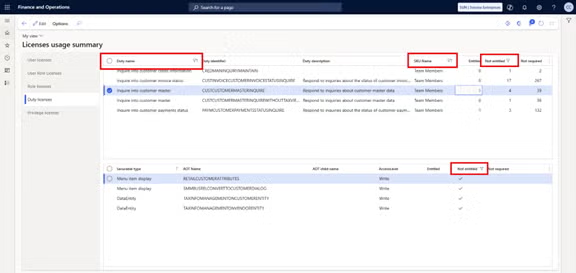
1. License Usage Summary

The User license summary page in the Security governance workspace shows how roles and permissions drive license requirements in Dynamics 365 Finance & Operations.

Microsoft Learn reference: User security governance license usage summary – Finance & Operations | Dynamics 365 | Microsoft Learn

Steps:

  1. Go to System Administration > Security governance > License Usage Summary.
  2. Under the Duty licenses fast tab, filter for view-only duties that may be triggering higher license requirements.
  3. Use the filters to identify any “Not Entitled” privileges for the selected license.

2. Security Categories and Process Hierarchy

Categories are used in the Process roles maintain module to organize roles by department or workstream. Setting up categories correctly reduces development costs when future security upgrades are needed.

Set up security categories – Finance & Operations | Dynamics 365 | Microsoft Learn

There are two ways to create a category:

  • Create a new category from scratch.
  • Import an existing category from another company.
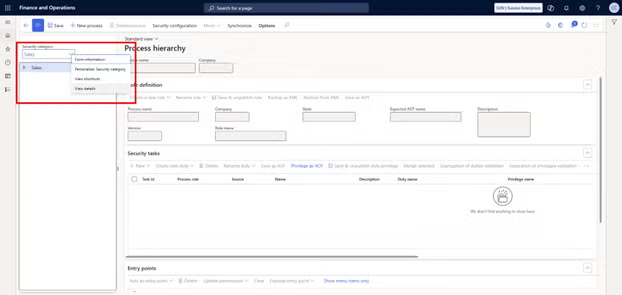
  1. Go to System administration > Security governance > Security category.
  2. Select New.
  3. Set the Name field.

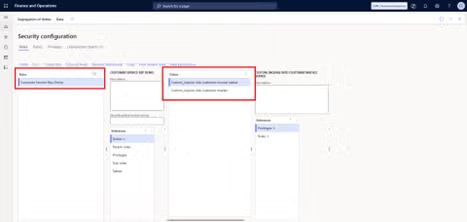
An alternative way to create security categories is captured in the screenshots below:

2.1 Process Hierarchy

A process hierarchy organizes and manages business processes by linking tasks, roles, entry points, and privileges. It allows roles to be built around position-based responsibilities, ensuring that access is aligned with the organization’s structure.

As a high-level guide, you can think of the areas in the Security process roles maintain form (also known as the Process hierarchy form) as follows:

  • Security category: Groups that represent a division, department, or workstream.
  • Process name: Each process results in a security Role.
  • Security task: Each task results in a security Duty and Privilege.
  • Entry points: The most detailed level where security is defined. This level matters because it is where you control read versus write access.

This approach makes roles easier to understand and define, while also improving UI effectiveness, controlling license costs, and reducing risk of data fraud.

Set up a process hierarchy, roles, and privileges – Finance & Operations | Dynamics 365 | Microsoft Learn

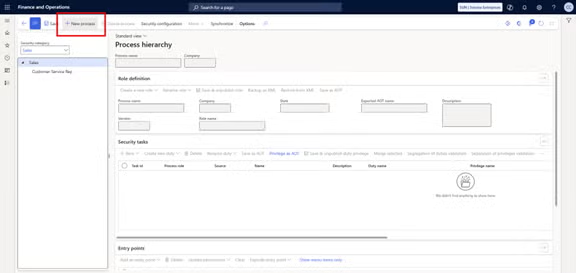
  1. Go to System administration > Security > Security governance > Security process role maintain.
  2. In the Security category field, select a category, and then select the desired tree level within that category.
  3. On the Action Pane, select New process.
  4. In the Process name field, enter a unique name for the process.
  5. Specify other details, such as a description and version information.

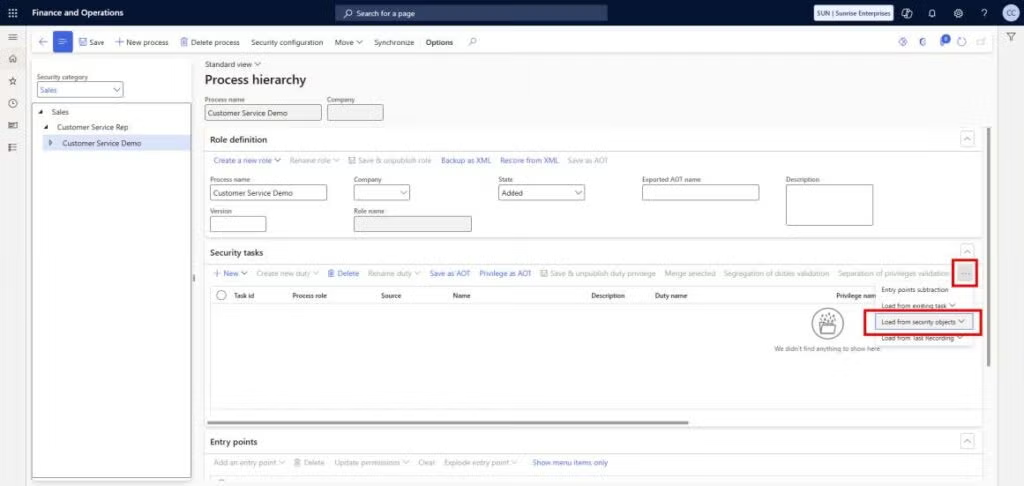
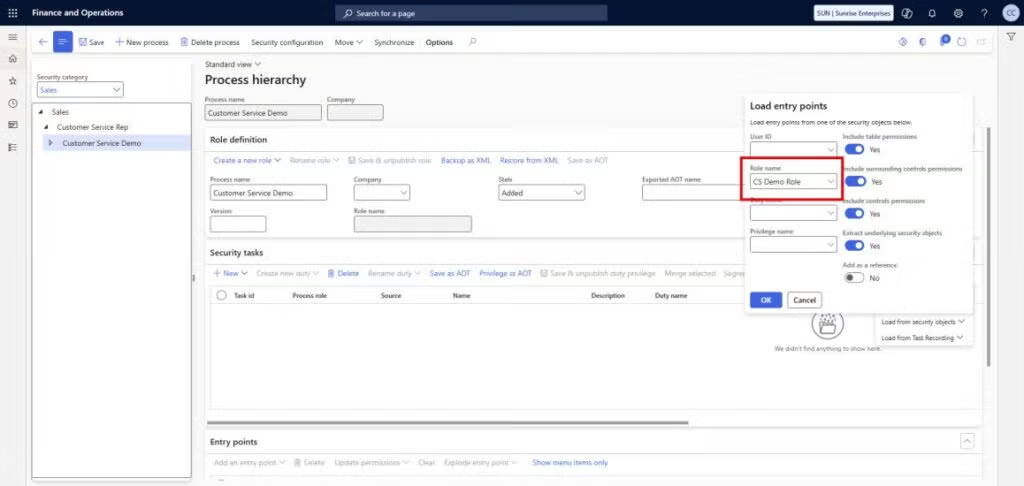
2.2 Load Entry Points from Security Objects

There are multiple ways to populate a new task, including creation from task existing tasks, security objects (user ID, roles, duties, privileges), or task recordings.

In this scenario, we want to make sure an existing role is fully read-only. To do this, we’ll import entry points from another role. This can be a role currently in use or an out-of-the-box role.

Steps:

  1. Choose the source role (in-use or out-of-the-box).
  2. For this example, we’ll select the CS Demo Role, which has two out-of-the-box duties assigned.

2.3 Create New Duties

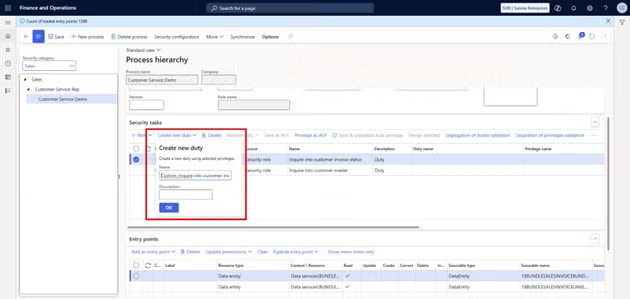
Out-of-the-box duties should not be edited, since they may be shared across multiple roles. Instead, create custom duties for this specific use case.

Steps:

  1. Select a security task record and copy its name.
  2. Create a new duty using a format such as: Custom_[DutyName].
  3. Repeat this process for each duty required.
  4. Keep the naming convention consistent for clarity.

Note: When you click OK to create a duty, it is immediately published into the system. If you are working in production, remember that these changes take effect right away.

2.4 Create a New Role

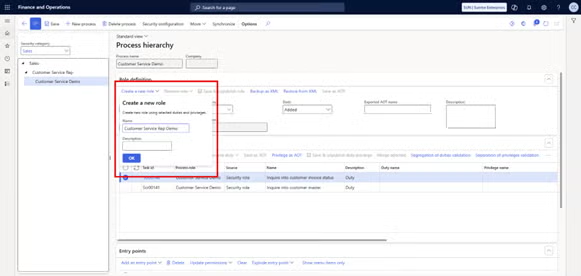
After creating the custom duties, the next step is to set up a new role.

Steps:

  1. Within the Role Definition fasttab, select Create new role.
  2. Enter a role name (for example, Customer Service Rep Demo).
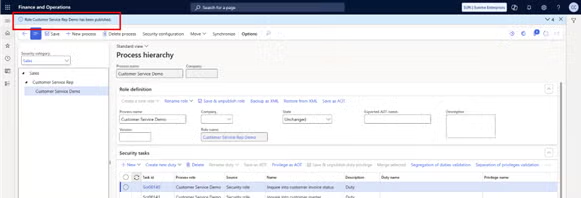
  3. Once created, the system will confirm that the role has been published.

At this stage, the new role will look the same as the role it was based on since the duties and privileges themselves haven’t yet been modified.

2.5 Ensure New Duties are Referenced on the New Role

After publishing the new role, confirm that the custom duties are correctly assigned.

Steps:

  1. Go to System Administration > Security > Security configuration.
  2. Filter for your custom role.
  3. Highlight the duties to verify that the custom duties you created are referenced on the role.

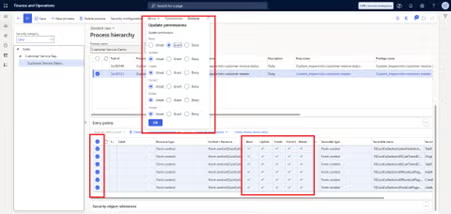
2.6 Update Permissions

After confirming that we’re working only with custom duties (and not editing the out-of-the-box ones), the next step is to change their entry points to read-only.

  1. Select the first duty.
  2. Review the entry points. Some may be set to Update, Create, Correct, or Delete. These actions cause higher license requirements.
  3. Select all entry points and choose Update permissions.
  4. Change the settings to Unset, except for Read, which should remain granted.
  5. Click OK.
  6. Repeat for remaining duties

Result: all entry points for this duty are now read-only, with no update, create, correct, or delete access.

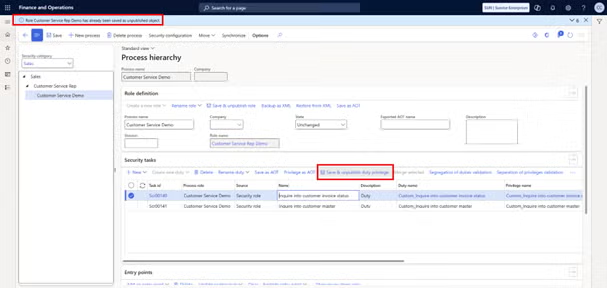
2.7 Save as an Unpublished Duty Privilege

Once the permissions are updated, the next step is to save the duty privileges as unpublished.

There’s a small quirk in the system here: the button is labeled “Save & unpublish duty privilege,” but what it really does is save the duty and privilege as unpublished.

For each duty:

  1. Select the duty and click Save & unpublish duty privilege (again, should say “Save as unpublished duty & privilege”)
  2. Confirm that it was saved as an unpublished object.
  3. Move to the next duty and repeat the same step.

2.8 Publish Role, Duties, and Privileges

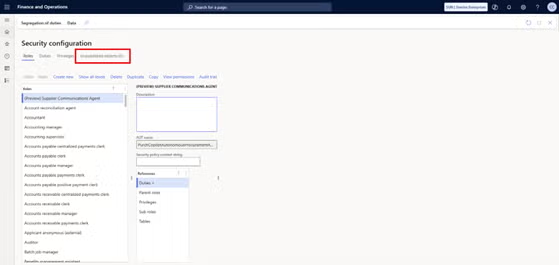
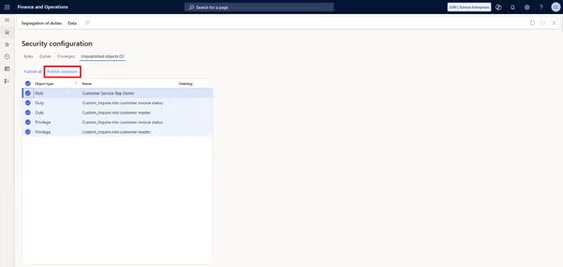
Next, go to Security Configuration to publish the changes.

  1. Go to System administration > Security > Security configuration
  2. Refresh the page to load the latest objects.
  3. You should see the unpublished items listed (for example, the new role, duties, and privileges you just created).
  4. Select the desired unpublished objects.
  5. Click Publish and confirm with Yes.

2.9 Verify Results

Once the objects are published, you can verify the results.

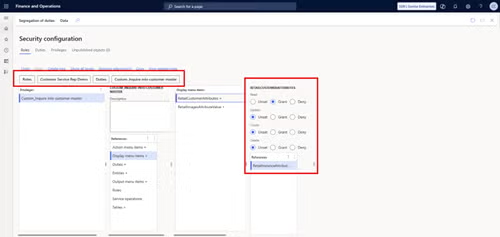
  1. Go to Roles and search for the custom role (for example, Customer Service Rep Demo).
  2. Open the role to confirm that the custom duties are assigned.
  3. Drill down into the privileges. What previously required Write access (such as retail customer attributes) should now be set to Read-only.

3. License Usage Summary Update

After publishing, return to the License Usage Summary screen.

  • The report will update within 2–8 hours.
  • Once refreshed, you should see the two custom duties you created.
  • The “Not Entitled” actions will no longer appear. Many will now show as “Not Required,” meaning they do not trigger a higher-tier license.
  • In this case, the duties should fall under the Team Member license level.

Get Organized about Dynamics 365 Licensing

Speak with a Microsoft Dynamics 365 licensing expert today. Reach out to us for a free license mapping assessment: we’ll help you identify potential cost savings and how you can optimize your Dynamics 365 licenses.

Get your team’s time back: How sales teams are using Copilot and AI to skip the boring stuff

Get Your Team's Time Back

How sales teams are using Copilot and AI to skip the boring stuff

CRM: Is it helping you or just creating a digital to-do list?

For far too many organizations, CRM has become a slog. Sales reps spend too much entering data into systems, when that time could be spent crafting a strategy. 

Picture this: A sales rep wraps up a call with a prospect. They should be focused on next steps: tailoring a proposal, looping in additional contacts, or finding answers to the prospect’s questions. Instead, they spend the next fifteen minutes logging notes, updating contact records, and trying to figure out where this lead should go next. 

Here’s another scenario: A new lead sits idle in an organization’s CRM system for hours or even days because the CRM doesn’t have intelligent routing capabilities. No one knows which territory the lead falls in or maybe the request is a gray area between teams. So the lead just…

…sits there, and precious time slips by. 

Even when teams implement detailed processes for gathering data, like engagement history, meeting notes, and demographics, if it doesn’t translate into action, that data is just gathering dust. 

These aren’t isolated annoyances. They add up. And over time, they erode productivity, stall pipeline velocity, and wear down your team.

The Solution: Embedded AI in Dynamics 365

This is where embedded AI, specifically Microsoft Copilot inside Dynamics 365, starts to flip the script.

Copilot is already built into the systems your team uses every day. No extra logins. No third-party integration headaches. Just smart automation, right where your team is already working.

Out of the box, Copilot can:

  • Write follow-up emails after meetings
  • Summarize leads, opportunities, and accounts in plain language
  • Surface key insights like engagement signals and past interactions
  • Suggest next best actions to move deals forward

It works directly inside the CRM record, in Outlook, and even in Teams. It keeps reps focused and in flow.

Dynamics 365: More Than Just CRM

Dynamics 365 isn’t just CRM software. It’s a full platform that connects sales, marketing, customer service, field ops, finance, and supply chain.

Everything runs on Microsoft’s shared data platform, Azure. That means sales reps, marketers, and support teams are all working off the same customer data. No spreadsheets. No back-and-forth with IT. Just one system with a complete view of the customer.

Because Copilot is built into this platform, it surfaces insights in context, exactly when and where your team needs them.

Case Study: Center for Creative Leadership

Let’s look at what this actually looks like in the wild.

We worked with a mid-sized B2B sales team that had a familiar problem. Leads were coming in from multiple channels, but the follow-up process was messy. Some reps got leads immediately. Others waited days. Nobody had a clear picture of what was falling through the cracks or why.

Sales operations was stuck manually routing leads and trying to keep everything on track.

Here’s what we did:

  1. Turned on Copilot inside Dynamics 365. That gave reps immediate summaries of new leads, including company info, engagement history, and product interest.
  2. Built a Power Automate flow to route leads automatically based on geography, vertical, and urgency. Leads from key accounts or hot territories went straight to assigned reps. Urgent inquiries were flagged and escalated.
  3. Layered in a lightweight Azure AI model to score leads based on likelihood to convert. This helped reps prioritize their time and gave managers visibility into pipeline quality.

The results within 30 days:

  • 80 percent faster lead response time
  • 35 percent increase in sales-qualified leads
  • Happier reps, clearer pipelines, and no more manual triage

And none of this required ripping out existing systems or launching a massive implementation.

Two Activation Paths for AI

Getting started doesn’t mean launching a huge digital transformation. Most teams start small. One workflow. One team. One pain point.

  1. Out-of-the-box Copilot

If you’re already using Dynamics 365, Copilot features are likely available to you now. With just a bit of configuration and quick team training, you can start using:

  • Auto-generated follow-up emails
  • Meeting summaries with action items
  • Inline lead and opportunity insights
  • Suggested actions inside CRM records

This is ideal for teams that want fast wins without changing their core processes.

  1. Custom Automation with Power Platform and Azure AI

For more complex workflows or integrations with marketing automation, ERP, or customer service, you can build:

  • Smart lead routing and alerts with Power Automate
  • Role-specific user interfaces with Power Apps
  • Predictive scoring and language recognition with Azure AI

These tools are low-code, quick to launch, and easy to scale. You can build what you need and evolve over time.

Want a Brainstorming Buddy? Get an AI Readiness Briefing

Not sure where to start? That’s exactly what the AI Readiness Briefing is for.

This free 30-minute session gives you:

  • A quick assessment of how your team uses CRM today
  • Clarity on where AI could save time and improve focus
  • A simple recommendation on which path to take
  • A realistic sense of what kind of ROI you can expect

It’s not a sales pitch. No pressure. Just a focused conversation to help your team get unstuck and move forward with confidence.

Get a free AI Readiness assessment

Contact us to speak with our Copilot and AI team today. They can help you identify AI use cases within your own organization, implement quickly, and realize value faster.

Dynamics 365 vs. NetSuite

Dynamics 365 vs. NetSuite

Comparing the two cloud ERPs

When comparing Dynamics 365 and NetSuite, think about the future

We often work with organizations that are evaluating NetSuite and Dynamics 365. While on the surface, both seem comparable in terms of capabilities, business functions, and infrastructure, there are some important distinctions. 

At Sunrise, we help growing businesses evaluate these platforms through the lens of future scalability, integration flexibility, and operational complexity. Whether your focus is on tightening your financial management, improving supply chain efficiency, or driving operational resilience, this article will guide you through a practical comparison of NetSuite and Dynamics 365 Finance and Operations—so you can choose the ERP that grows with your business.

Dynamics 365 Overview

Dynamics 365 is a suite of applications that unifies processes across finance, supply chain, commerce, and customer service on a single platform. Its integration with other Microsoft products, such as Office 365 and Azure, provides a seamless experience for users familiar with the Microsoft ecosystem.

Built to support growing businesses, Dynamics 365 offers modular applications that can be implemented individually or together, allowing organizations to start with what they need and scale at their own pace. With built-in AI capabilities like Microsoft Copilot, businesses gain intelligent insights, improve decision-making, and automate repetitive tasks. Additionally, its low-code/no-code tools, such as Power Apps and Power Automate make customization accessible even without deep technical expertise.

Whether it’s optimizing financial operations, managing complex supply chains, or improving customer experiences, Dynamics 365 delivers a connected and flexible solution for modern enterprises.

NetSuite Overview

NetSuite provides foundational inventory management capabilities, including demand planning, automated replenishment, and basic warehouse tracking. Its Saved Searches and customizable dashboards offer valuable visibility, making it well-suited for businesses with simple product catalogs and straightforward inventory requirements.

However, companies that require more sophisticated features—such as real-time serialization, complex global inventory coordination, or support for multi-dimensional SKUs—may find NetSuite’s functionality limited in those areas.

Comparison table: NetSuite vs. Dynamics 365 Finance and Supply Chain

Below is a detailed comparison of the two systems:

Feature CategoryNetSuiteMicrosoft Dynamics 365
Merchandising & inventory managementNetSuite offers essential tools for managing inventory across locations, including demand planning, replenishment automation, and basic warehouse tracking. Its saved searches and customizable dashboards provide useful insights, making it a strong fit for companies with relatively straightforward product catalogs and inventory needs. While NetSuite covers these functions, it may fall short for businesses needing advanced capabilities like real-time serialization, global inventory coordination, or multidimensional SKU management.

Dynamics 365 excels in complex supply chain environments, offering multi-level product hierarchies, serial and batch tracking, and AI-driven demand forecasting. Its tight integration with warehouse automation systems, barcode scanning, and mobile inventory workflows make it ideal for manufacturers, distributors, and global retailers.

Dynamics 365 Supply Chain Management also supports cross-border inventory tracking, landed cost calculations, and real-time visibility across warehouses, empowering companies to enhance logistics performance and reduce stockouts or overstock situations.

Point of Sale (POS)NetSuite includes a native POS module and solid eCommerce functionality that works well for retail environments with modest channel complexity. It enables centralized data for sales, inventory, and customer transactions but often requires third-party tools or add-ons for a true omnichannel experience. While suitable for B2C brands with straightforward processes, NetSuite can be limiting for businesses that demand real-time store operations, complex promotions, or B2B commerce coordination across multiple regions.Pairing Microsoft Dynamics Finance and Supply Chain with Commerce delivers a powerful, end-to-end omnichannel solution. From in-store POS and mobile checkout to digital storefronts and marketplace integrations, the platform offers a single source of truth across every touchpoint. Built-in tools enable real-time customer insights, synchronized inventory, and dynamic pricing—empowering companies to elevate service and drive loyalty. The deep integration with other Dynamics 365 ecosystem apps like Customer Insights, Power BI, and Microsoft Teams enhances collaboration and personalization.
Financial managementNetSuite provides robust out-of-the-box finance and accounting functionality, including general ledger, accounts receivable/payable, bank reconciliation, and basic financial analysis tools. Its SuiteBilling module supports subscription-based models, making it ideal for SaaS and services businesses. However, its capabilities can feel limited for organizations with complex reporting structures, intercompany transactions, or compliance needs tied to GAAP or IFRS standards.

Dynamics 365 is built for global organizations with multidimensional and complex accounting needs. With features like multi-entity accounting, real-time budgeting, fixed asset tracking, subscription billing, cost accounting, and automated revenue recognition, Dynamics 365 Finance supports the needs of both finance teams and auditors.

The app’s native support for local tax regulations, multi-currency consolidation, and project-based accounting makes it particularly attractive for global firms. Additionally, embedded Power BI dashboards and Microsoft Copilot enable predictive insights and scenario modeling to help finance leaders stay ahead.

Omnichannel capabilitiesProvides omnichannel support through its SuiteCommerce platform, which connects eCommerce, in-store POS, and order management systems. While it offers essential capabilities like real-time inventory tracking and customer data unification, delivering a fully integrated omnichannel experience may require additional setup, third-party tools, or custom development.Supports omnichannel retailing through Dynamics 365 Commerce, allowing for cohesive customer experiences across online and offline channels. Features include unified customer profiles, cross-channel loyalty programs, and seamless order fulfillment processes.
Customization & integration

NetSuite promotes a “clicks not code” approach to customization. Using SuiteBuilder and SuiteCloud, users can configure fields, workflows, and dashboards with relative ease. Developers can extend functionality using SuiteScript, a JavaScript-based scripting language, and REST or SOAP APIs for system integration.

This low-code environment works well for companies with lighter customization needs, but limitations emerge when building deeply integrated, cross-platform business processes—especially those spanning CRM, finance, supply chain, and analytics.

Dynamics 365 F&O stands out with its tight integration into the Microsoft Power Platform. Using Power Automate, Power Apps, and Azure Logic Apps, businesses can build custom workflows, automate approvals, and connect F&O to virtually any system—without heavy development overhead.

Additionally, Microsoft’s Dataverse provides a unified data layer across Dynamics applications, making integration with Microsoft 365, Power BI, and Teams seamless. AI-driven recommendations through Copilot enhance productivity by suggesting smart workflows based on user behavior and context.

User experience & interfaceOffers a functional, dashboard-driven interface with strong data visibility. However, the UI can feel dated and less intuitive, often requiring more training or technical input.Features a modern interface consistent with other Microsoft products like Office 365, providing a familiar environment for users. The system offers customizable dashboards, workspaces, and a responsive design, enhancing user engagement across
Scalability & deploymentNetSuite is offered as a single-tier, multi-tenant SaaS solution, making deployment fast and upgrades automatic. This model is ideal for businesses seeking a streamlined path to ERP adoption without dedicating large IT resources.Dynamics 365 F&O provides enterprise-class scalability through modular licensing, regional Azure deployments, and flexible infrastructure configurations. Businesses can adopt what they need today—finance, supply chain, commerce—and scale into manufacturing, HR, or advanced analytics later.
Licensing & costsIts pricing includes bundled modules, which helps simplify procurement. However, that simplicity can lead to long-term trade-offs: limited control over upgrade timing, reliance on third-party solutions for industry-specific needs, and potential functional ceilings as business processes mature.The ability to control upgrade timing and deploy in specific geographies (for compliance or latency reasons) makes it highly attractive to global and multi-entity organizations. While initial licensing may seem higher, many businesses find the total cost of ownership (TCO) favorable over time due to fewer workarounds and more built-in functionality.
Customer supportOffers tiered support plans, but advanced support often comes at a premium. While resources like the NetSuite Help Center and SuiteAnswers are available, users frequently rely on third-party consultants for in-depth support and system customization—something more streamlined in the Dynamics 365 partner ecosystem.Microsoft offers Standard, Premier, and Unified Support. Some Microsoft Partners offer ongoing support programs, from handling maintenance and upgrades to implementing new modules and capabilities.

What about AI capabilities in Dynamics 365 vs. NetSuite?

Dynamics 365 is ahead of the curve when it comes to built-in AI. With the introduction of Microsoft Copilot, Dynamics 365 brings conversational AI and generative insights directly into ERP and CRM workflows. Users can automate tasks like invoice creation, email drafting, and report generation using natural language. Additionally, its deep integration with the Microsoft Power Platform (Power BI, Power Automate, Power Apps) allows users to build AI-powered dashboards, automate decision trees, and analyze trends using predictive analytics — all without heavy coding.

Microsoft’s ecosystem advantage plays a big role here: businesses using Teams, Outlook, or SharePoint can experience AI-enhanced workflows across systems, making Dynamics 365 a very intelligent and connected solution out-of-the-box.

NetSuite, while good in automation and reporting, is still catching up in AI features. It does offer machine learning in some areas like cash flow forecasting, demand planning, and anomaly detection, primarily through its SuiteAnalytics and SuitePeople modules. However, much of the advanced AI functionality often requires integration with third-party tools or custom development.

Oracle has introduced AI innovations across its broader cloud ecosystem, and these features are gradually surfacing in NetSuite, but the experience isn’t as deeply embedded or accessible yet compared to Dynamics 365.

The bottom line? You might outgrow NetSuite, too

…and end up right back where you started, looking for a replacement ERP system. NetSuite is a strong contender for businesses looking for rapid deployment, foundational financial management, and streamlining operations across a limited number of entities. For organizations with standard workflows and modest customization needs, NetSuite is a compelling starter cloud ERP.

However, for companies navigating global operations, complex supply chains, advanced warehousing and logistics needs, and long-term scalability, Dynamics 365 Finance and Supply Chain is the clear winner.

  • Advanced planning capabilities: Embedded demand forecasting, MRP, and AI-driven insights enable smarter supply chain decisions.

  • AI roadmap: Microsoft Copilot delivers real-time, embedded AI across finance, operations, and customer engagement modules, no integrations required.

  • Power Platform: Build custom apps, workflows, and automation with low-code tools like Power Apps and Power Automate, fully integrated with your ERP.

  • Seamless omnichannel capabilities: Unify in-store, online, and back-office operations with Dynamics 365 Commerce for consistent customer experiences.

  • Modern, intuitive UI: A user-friendly, Microsoft-aligned interface that reduces training time and boosts adoption.

  • Automatic updates & innovation: Benefit from continuous improvements and feature rollouts without disruption.

  • Microsoft ecosystem integration: Deep, native connectivity with Teams, Outlook, Excel, Azure, and more, enabling truly unified business operations.

When your business demands more than the basics, Dynamics 365 isn’t just the next step; it’s the strategic upgrade.

Frequently asked questions

NetSuite is a cloud-based ERP designed for mid-sized businesses with simpler processes, while Microsoft Dynamics 365 offers a modular, enterprise-grade ERP and CRM suite built for scalability, complex operations, and deep integration with the Microsoft ecosystem.

Yes. Dynamics 365 allows businesses to start with core modules and expand to areas like HR, manufacturing, and advanced analytics as they grow. It supports complex configurations and global rollouts, making it ideal for scaling.

NetSuite covers basic supply chain needs but lacks the deep features of Dynamics 365, such as AI-driven forecasting, landed cost calculations, and real-time visibility across global warehouses.

Dynamics 365 offers advanced financial tools including multi-entity accounting, cost tracking, subscription billing, and GAAP/IFRS compliance. NetSuite is strong in core finance but may fall short for complex reporting or compliance needs.

Both support these features, but Dynamics 365 handles them more comprehensively, with built-in consolidation, intercompany processing, and compliance tools.

Dynamics 365 excels in this area with embedded Power BI and native compliance tools. NetSuite handles standard reporting well but may require additional tools or services for advanced needs.

Dynamics 365 is preferred for manufacturing due to its support for MRP, BOMs, shop floor control, and integration with warehouse systems. NetSuite offers manufacturing features but is less robust.

Yes. Dynamics 365 uses AI for demand forecasting and planning. NetSuite includes demand planning but lacks predictive AI-driven insights.

Dynamics 365 offers a modern, Office-like interface with customizable dashboards and workspaces. NetSuite’s interface is functional but may feel dated and require more training.

Dynamics 365 leads in embedded AI with Copilot, enabling task automation, insights, and predictive analytics. NetSuite has some machine learning features but is still evolving in AI.

Dynamics 365 may have a higher upfront cost, but its total cost of ownership (TCO) can be lower due to fewer third-party tools and broader built-in features.

NetSuite offers tiered support, with advanced help often costing more. Microsoft provides Standard, Premier, and Unified support, with partner-led programs offering personalized service.

Dynamics 365 benefits from Microsoft’s global partner network and a strong ecosystem. NetSuite has certified partners too, but some users rely more on third-party consultants.

Yes. Many businesses migrate from NetSuite to Dynamics 365 as their operational complexity increases. Migration involves data mapping, platform configuration, and training.

Dynamics 365 is considered more future-proof due to embedded AI, Microsoft integration, modular design, and continuous innovation through the Microsoft Cloud roadmap.

Dynamics 365 is Your Forever System

If you’re deciding between Dynamics 365 and NetSuite, now is the time to explore your options. A smooth migration to Dynamics 365 can future-proof your business, reduce costs, and improve efficiency. Contact us today for a free assessment. Our experts will help you map out a cost-effective path forward and give you a blueprint for a successful ERP project.

Dynamics 365 license management & cleanup guide

Dynamics 365 License Management

Use this license cleanup guide to prepare for changes to Dynamics 365 license enforcement

Microsoft is introducing new tools to monitor and manage D365 licenses

Microsoft is cracking down on Dynamics 365 license enforcement. New tools and reports promise to make managing users easier, but on January 15, 2026, users who haven’t been assigned a license will lose access to their Finance and Operations production environments.

Don’t get caught by surprise! Below is a step-by-step guide on how to reconcile system users with your current licenses and subscriptions, assign named users to licenses, and ensure you’re compliant with Microsoft’s requirements.

Key dates to remember

September 1, 2025

  • Users who haven’t been assigned a license will see a notification when they log in to Dynamics 365 Finance & Operations, prompting them to contact their administrator.

November 1, 2025

  • Users who haven’t been assigned a license will lose access to their Dynamics 365 Finance & Operations production environments.

Part 1. Log in to Power Platform Admin Center (PPAC) license reporting

Find your current license utilization report here:

  1. Go to https://admin.powerplatform.microsoft.com.
  2. Make sure to toggle on the “New Admin center” look in the upper right-hand corner.
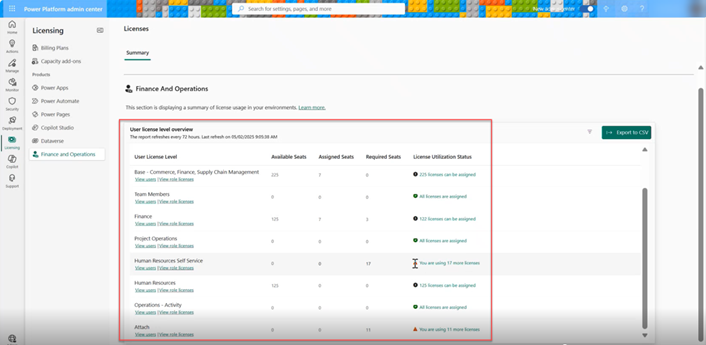
  3. Go to Licensing > Finance and Operations. By default, the form filters to your production environment.
  4. Screenshot the page for easy reference. You should have a report that looks like this:
    A screenshot of the licenses summary page in Power Platform Admin Center (PPAC), showing an overview of user licenses in Finance and Operations.
  5. Look at the License Utilization Status column and refer to the chart below for what to do for each scenario:
ScenarioWhat it meansNext action
No Issues:


Available Seats ≥ Required Seats and all are Assigned

Utilization Status: “All licenses are assigned.”

You’re good to go! All available seats cover your user requirements, and every user has been assigned a license.No action required. Consider reducing your total licenses if excess capacity exists.
Fully licensed but need assignments:


Available Seats ≥ Required seats, but are not fully assigned

Utilization Status: “X licenses can be assigned.”

Sufficient licenses exist, but some users haven’t been assigned a license.Assign licenses to unlicensed users.
Under licensed:


Available Seats < Required Seats

Utilization Status: “You are using X more licenses.”

More users are triggering license requirements than you have seats for.Perform an audit: review security roles, reduce permissions or duties, or determine if more licenses are needed. Then assign licenses to users.

Note about Device licenses:

Device licenses and usage are not included in the PPAC license report. We recommend that you manually track physical device usage (such as warehouse scanners and POS terminals) and ensure purchased quantities match your needs.

What to do if you are under-licensed

Time for a true-up!

Export the PPAC license report to CSV for use in detailed analysis:

  • In the top right of the overview section, click Export to CSV.
  • The Download license information slider pop-up will appear. Click Start to generate the file and download.
  • This report will show all users and the associated license types being triggered as required.

Create a separate master list of all expected current F&O users:

  • To compare against the PPAC report, you’ll need to create a table of your current F&O users if you haven’t already. Exporting your F&O security roles can give you a base list to start. We recommend you include the following:
    • Email or user ID
    • Plain language job title and description (e.g., “Accounts Payable Clerk”)
    • Your expected license type for each user (Team Member, Operations Activity, Base Supply Chain, Base Finance, etc.)

Now you can compare the two lists:

  • Flag any specific users or roles that appear to be incorrectly assigned a higher-than-expected license.
    • For example, you might find a read-only user that shows up as requiring a full Base or Activity license. This is important because you will later investigate what F&O permissions are triggering the unnecessarily higher license.

Now that you’ve exported the PPAC license report and compared it against your list, it’s time to analyze user role permissions in Dynamics 365 Finance & Operations.

Part 2. Dynamics 365 license cleanup and reconciliation process

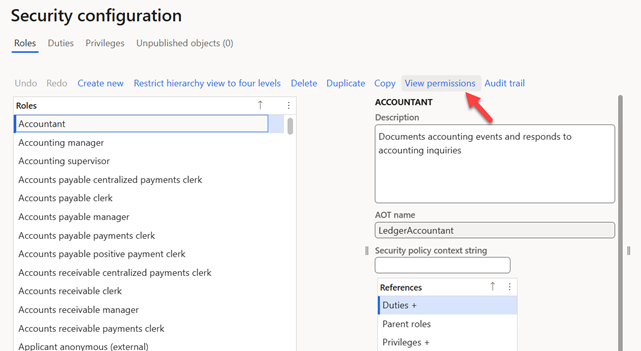
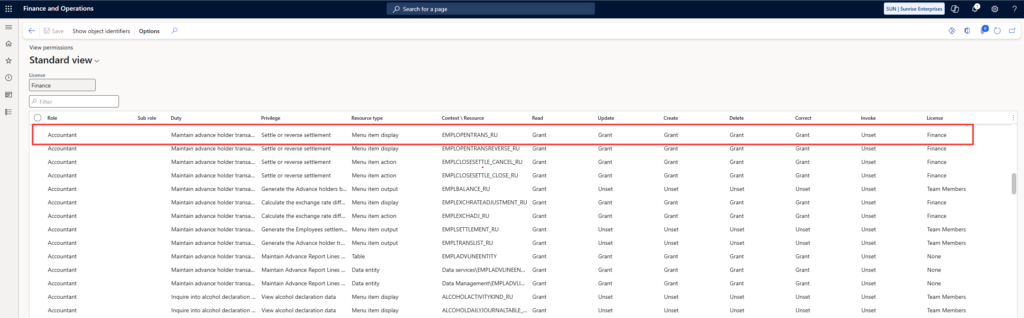
1. Analyze role permissions in F&O

In Finance & Operations, go to System Administration > Security Configuration. Select the user role in question, click “View Permissions” and review Duties/Privileges that are contributing to the license tier:

A screenshot of the Security configuration-Roles page in Dynamics 365 Finance and Operations.

A screenshot of Finance and Operations, showing the user permissions for an Accountant role.

2. Optimize custom roles

If using custom roles, consider duplicating and modifying them to remove non-essential privileges or duties. Ensure the new role supports business needs while minimizing license impact.

3. Submit licensing disputes

If specific privileges are still triggering higher licenses and you believe they shouldn’t, document them and escalate with your partner and/or Microsoft.

Types of Dynamics 365 licenses

Below is a simplified summary of the different Dynamics 365 F&O user-based license types. For the full description of each license, refer to the latest edition of the Microsoft Dynamics 365 licensing guide: link

(Note: the above is a link to the May 2025 licensing guide. To find the latest Dynamics 365 licensing guide at any time, visit the Microsoft resource site: Licensing Documents.

License TypeDescription
Team MemberMostly read-only users. Can view data and reports. Limited transactional rights.
Activity

Approvers, warehouse, or shop floor users who interact via shared terminals or perform confirmations. Depending on access requirements, Activity license holders can also include customer service and order entry personnel.

Operations–Activity users generally are allowed to:

  • Create and edit items related to
    • Orders (sales and purchase orders)
    • Vendor maintenance
    • Warehousing (receiving and shipping)
    • Budgets
  • Record and approve:
  • Operate POS devices (depending on their role and if licensed accordingly)

Examples of allowed tasks:

  • Entering or editing sales or purchase orders
  • Modifying basic vendor or inventory details associated with an order
  • Participating in approval workflows related to order entries (within their permission scope)
  • Updating order line items under specific constraints
BaseFull or transactional access. Includes finance, inventory, or production responsibilities. Attach-type licenses are required when using multiple Base functionality areas (e.g., Finance, Supply Chain, Commerce, Project Operations, etc.).

Tips for managing your Dynamics 356 licenses

We have found the following simple tips greatly helpful:

  • Create one parent role per user job type, where possible, to simplify future license analysis.
  • Use naming conventions for custom roles that reflect the job title or team.
  • Perform all edits in a sandbox environment first, then promote to production.

Part 3. Ongoing maintenance: Review Dynamics licensing assignments in Power Platform Admin Center

Starting in 2025, Microsoft requires that all D365 Finance & Operations users be explicitly assigned a license through the Power Platform Admin Center. This ensures correct access and avoids unexpected license errors. To look up users that need to be assigned a license, follow these steps:

1. Go to https://admin.powerplatform.microsoft.com
2. Make sure to toggle on the “New Admin center” look in the upper right-hand corner.
3. Go to Licensing > Finance and Operations. By default, the form auto-filters to the production environment.
4. Review the list of users to identify those who are unassigned or incorrectly assigned.
5. To assign users, continue to the next step.

Part 4. Assign users to licenses in Microsoft 365 Admin Center

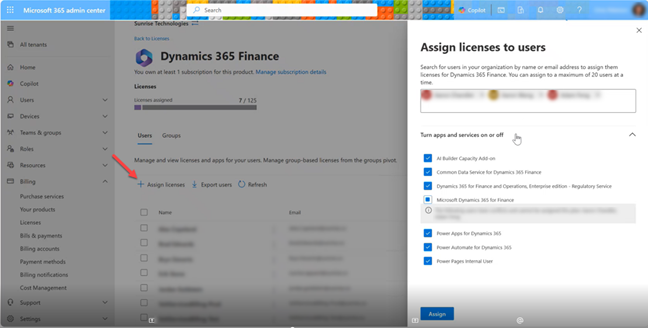
If you identify a user or group in PPAC that needs a license assigned, you’ll make the assignment in the Microsoft 365 Admin Center. Here’s how:

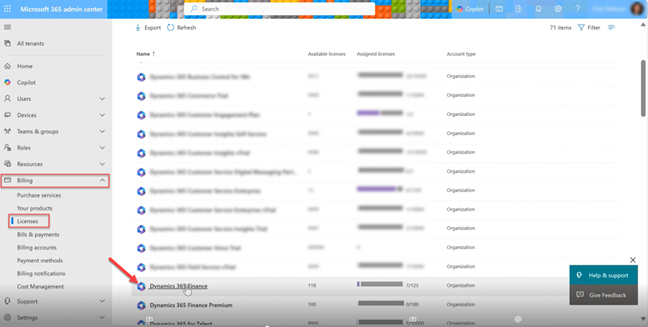
1. Go to the Microsoft 365 Admin Center (https://admin.microsoft.com> Billing > Licenses.
2. Select the desired license name, such as Dynamics 365 Finance.
3. Select Assign licenses > add the desired user(s) to assign > click Assign.

Tip: You may want to create and then assign Entra groups for sets of users requiring the same license type.

A screenshot of the Microsoft 365 Admin Center, where users can be assigned Dynamics 365 licenses.

A screenshot of the Microsoft 365 Admin Center and screen where you assign licenses to users,

Frequently asked questions

Yes, we have seen recent inaccuracy issues with reporting in PPAC as Microsoft releases new features. The Microsoft product team is actively working on resolutions.

Microsoft is refining and restructuring PPAC and making significant changes to its layout and functionality. In the future, PPAC will be a centralized hub for managing both licenses and environments.

In the meantime, it’s critical to assign licenses to users. We recommend you independently track your expected user counts, actual system users, and assigned security roles to establish a reliable baseline to compare against PPAC’s data.

It’s important to independently track your expected user counts, actual system users, and assigned security roles to establish your license baseline for comparison against PPAC’s reports. This blog post contains detailed instructions for comparing your license actuals against what’s in PPAC. Here’s a summary of the process:

  • Create a master list of all current Dynamics users.
  • Clean up current licenses: Assign purchased licenses to your users in the Microsoft 365 Admin Center and delete expired users from the system.
  • Export the report of Dynamics users from PPAC (note: this report only refreshes every 72 hours).
  • Compare your expected users versus the list in PPAC.
  • Note and investigate any discrepancies.
  • Analyze security roles and role permissions in F&O to identify any permissions that may trigger a higher-level license (i.e., Base license versus Activity license).
  • Adjust permissions in each role as needed.
  • Re-run the PPAC report. Note: License assignments take place in real time in Microsoft 365 but it takes 72 hours for changes to be reflected in the PPAC report.

Microsoft has not yet released formal guidance on how it will check for compliance. However, at this point we recommend assuming that license validation will occur at the license type level. This is signaled by the PPAC report, which audits expected user counts by license type and outlines the number of users required per license category.

Microsoft is introducing significant enhancements to security governance in Dynamics 365 Finance and Operations, aiming to provide administrators with more robust tools for managing user roles, ensuring compliance, and optimizing licensing. These are currently in preview and expected to be released in July 2025 (Dynamics version 10.0.44). These features will greatly speed up security role creation, analysis, and adjustments.

As it specifically relates to licensing:

Microsoft 365 Admin Center:

  • Used for all licensing assignments.
  • View available licenses vs. assigned licenses.

Power Platform Admin Center (PPAC):

  • View F&O license utilization status. PPAC shows not only your available and assigned licenses, but also required licenses and suggested actions.
    • Don’t forget: Reports refresh once every 72 hours.
  • Download detailed user/role/license information.
  • View storage utilization status.

Lifecycle Services (LCS):

  • Features will be released to show license reporting from PPAC. This feature is being added to LCS because Microsoft understands that F&O customers and partners often use LCS, whereas PPAC access is often more restricted.
  • Note that in time, LCS is planned for deprecation.

Get a free license mapping assessment

Contact us to speak with a licensing expert today. We can help you prepare for Microsoft’s upcoming license enforcement changes and optimize costs.

What is Quick Migrate? An overview of our data migration tool

What is Quick Migrate?

An overview of our data migration tool

Accelerate Your Data Migration with Confidence

Sunrise QuickMigrate is the fastest and most reliable way to migrate legacy data to Microsoft Dynamics 365 Finance and Operations (D365 F&O). Built on Azure Data Factory and Power BI, QuickMigrate automates, validates, and accelerates your entire D365 data migration process—reducing project risks and saving hundreds of hours. Whether you’re planning a large-scale implementation or preparing for a go-live, QuickMigrate ensures your data migration is efficient, accurate, and stress-free.

Why Automate Your Dynamics 365 Data Migration?

Migrating data into D365 F&O is one of the most critical—and challenging—parts of any ERP project. QuickMigrate eliminates common data migration pain points:

  • Automated Data Extraction, Transformation, and Loading: Replace error-prone manual file handling with Azure Data Factory pipelines that automate the ETL process for Dynamics 365 migrations.
  • Built-In Data Validation and Comparison: Use integrated Power BI dashboards to verify data accuracy between legacy systems and D365 F&O at every migration cycle.
  • Simplified Error Management: Centralized dashboards make it easy to find, fix, and reprocess data errors without digging through D365’s Data Management workspace.
  • Faster Iterative Migration Cycles: Quickly manage multiple environments (Dev, UAT, Prod) and run migration cycles for CRPs, SITs, and Go-Lives with full tracking and reporting.
  • Self-Service Flexibility: Hosted in your Azure subscription, QuickMigrate empowers both consultants and client teams to manage migrations independently.

How Sunrise QuickMigrate Works

QuickMigrate automates every major phase of a Dynamics 365 Finance and Operations data migration:

  1. Extract and Transform Data: Pull data from legacy ERP systems, clean and transform it using pre-defined Azure Data Factory pipelines.
  2. Load into D365 F&O: Automatically create and run D365 Data Management projects to load master and transactional data.
  3. Validate Data Accuracy: Export data post-load, then run source-to-target comparison with visual insights from Power BI dashboards.
  4. Iterate Quickly: Manage multiple cycles seamlessly—from early CRPs to final go-live migrations—with change tracking and error resolution built in.

Work with an ERP Partner that Knows Your Industry

Planning an ERP project? Reach out to schedule a call with us today. We work with companies of all sizes to modernize their operations on a single platform—Dynamics 365.

Dynamics 365 licensing guide

Dynamics 365 Licensing Guide

Check out the latest edition of the Dynamics 365 licensing guide, released in May 2026. It’s a comprehensive resource for understanding how Microsoft licenses its suite of business applications across finance, operations, sales, customer service, and more. This educational guide explains the types of licenses available—user, device, and tenant—and outlines the latest pricing, purchase channels, capacity entitlements, and use rights. Whether you’re evaluating Dynamics 365 for the first time or expanding your current deployment, this guide will help you make informed decisions, avoid costly licensing mistakes, and align your investment with actual usage.


Do you have questions about your specific situation? Our experts can help you map out the most cost-effective way to license Dynamics 365 for your organization. Contact us for a free assessment and licensing blueprint.

Start Your Journey with Sunrise Today!

Whether you’re exploring your options for new business platforms, or ready to get started, we are trusted business partners for some of the world’s most well-known brands. With over 25 years of experience with the Microsoft stack, we can help you understand all the capabilities Microsoft has to offer.

Dynamics 365 vs. Island Pacific

Island Pacific vs. Dynamics 365: A comparison

When on-premise systems reach end of life, retailers are often at a crossroads

What happens when your on-premise infrastructure reaches its end of life?

Retailers running Island Pacific ERP on-premise are no strangers to hardware deprecation announcements. While the ERP software itself will continue to be supported, IBM’s Power 9 servers—which many Island Pacific users rely on—will reach end of life on January 31, 2026. That leaves retailers with two choices:

  1. Invest in a costly, time-consuming server upgrade to keep running Island Pacific on-premise.
  2. Seize the opportunity to migrate to the cloud and modernize their ERP strategy.

For decades, the Island Pacific + IBM Power server combination was a strong choice for retail operations. However, the retail landscape has evolved significantly, and the capabilities that today’s businesses need—scalability, AI-driven analytics, omnichannel commerce, and real-time insights—are difficult (if not impossible) to achieve on aging, on-premise hardware.
Deprecation announcements like this aren’t just obstacles—they’re a chance to rethink the future. Instead of doubling down on legacy infrastructure, retailers can evaluate cloud-based ERP solutions like Microsoft Dynamics 365 to expand capabilities, enhance agility, and position themselves for future growth.

What hardware is approaching end-of-life for Island Pacific?

It’s important to note that support for the Island Pacific ERP system is NOT ending; support for IBM’s Power 9 servers, is ending on January 31, 2026. If you’re an Island Pacific user, you can keep using your ERP system on-premise by upgrading your servers, but that’s an expensive and time-consuming prospect.

Even though organizations in every industry face this same dilemma, this blog focuses on retailers in particular since we encounter this scenario often. Moving off legacy infrastructure and onto the cloud opens up a realm of possibilities for retailers to modernize their brands.

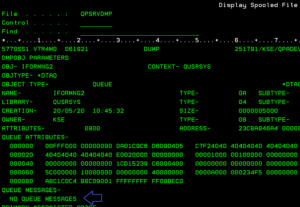
A picture of Island Pacific retail software on an old AS400 iSeries computer screen.

If your business systems look like this, it may be time for a change.

Island Pacific vs. Dynamics 365: Which is the better choice for retailers?

Island Pacific is a global leader in providing retail software solutions to help retailers manage and optimize their operations across multiple channels. The company’s flagship product, Island Pacific SmartSuite, offers a comprehensive suite of modules designed to streamline retail operations. These modules include merchandising, replenishment, financials, sales audit, warehousing, and ticketing functionalities.
Dynamics 365 is a suite of applications that unify processes across finance, supply chain, commerce, and customer service on a single platform. Its integration with other Microsoft products, such as Office 365 and Azure, provides a seamless experience for users familiar with the Microsoft ecosystem.

Feature CategoryIsland PacificMicrosoft Dynamics 365
Merchandising & inventory managementOffers a robust merchandising system through its SmartRetail module, enabling retailers to manage product assortments, pricing, promotions, and inventory across multiple channels. The system provides real-time visibility into stock levels, facilitating efficient inventory control.Provides comprehensive inventory management features within Dynamics 365 Supply Chain Management. Users can track inventory levels, manage procurement processes, and optimize warehouse operations. The system supports real-time analytics to forecast demand and adjust inventory accordingly. Partners also offer solutions to customize Supply Chain Management for retailers, with advanced inventory allocation capabilities.
Point of Sale (POS)Features the SmartStore module, which includes fixed and mobile POS solutions. These systems are designed to enhance in-store customer experiences by providing seamless transaction processing and integrating with back-end systems for real-time data synchronization.Offers POS capabilities through Dynamics 365 Commerce, enabling unified retail experiences across physical and digital channels. The system supports personalized customer engagements, centralized payment processing, and integrated inventory management.
Financial managementIncludes a Financials module that interfaces tightly with merchandising and warehouse functions, ensuring seamless invoice matching and financial reporting. Retailers can manage accounts payable, chart of accounts, and extract stock ledger data efficiently.Dynamics 365 Finance offers global financial management capabilities, including budgeting, costing, consolidation, and financial reporting. Its integration with Power BI allows for in-depth financial analytics and insights. AI and Copilot capabilities can help automate and streamline financial processes.
Omnichannel capabilitiesSmartOmni provides a centralized view of inventory across all channels, enabling retailers to offer flexible fulfillment options such as ship-from-store and click-and-collect. This ensures a consistent customer experience regardless of the purchasing platform.Supports omnichannel retailing through Dynamics 365 Commerce, allowing for cohesive customer experiences across online and offline channels. Features include unified customer profiles, cross-channel loyalty programs, and seamless order fulfillment processes.
Customization & integrationHighly flexible and modular system, allowing retailers to integrate third-party apps and customize solutions as needed. Retail-specific features work well within the platform but limited API support makes integrating with other tools difficult.Dynamics 365 apps have an extensibility model that lets you extend the built-in functionality to fit different requirements. More customization options are also available through the Microsoft Power Platform, allowing businesses to develop custom workflows. Dynamics 365’s native integration with other Microsoft services ensures a cohesive ecosystem for users.
User experience & interfaceEmphasizes a user-friendly interface with intuitive dashboards, enabling quick adoption by retail staff. The system’s design focuses on streamlining retail operations, reducing the learning curve for new users.Features a modern interface consistent with other Microsoft products like Office 365, providing a familiar environment for users. The system offers customizable dashboards, workspaces, and a responsive design, enhancing user engagement across
Scalability & deploymentOffers both on-premises and cloud-based solutions, allowing retailers to scale operations as their business grows. The modular nature of SmartSuite enables businesses to add functionalities incrementally.Primarily a cloud-based solution, it offers scalability to accommodate businesses of varying sizes. The platform’s architecture supports global operations, making it suitable for enterprises with expansive reach.
Licensing & costsPricing details are typically customized based on the specific modules selected and the scale of deployment.  Infrastructure for on-premises deployments can add significant costs.Operates on a subscription-based model, with pricing varying depending on the selected apps and user count. A Microsoft partner with retail industry experience can help you estimate your licensing and Azure subscription costs.
Customer supportPersonalized customer service is available for enterprise clients.Microsoft offers Standard, Premier, and Unified Support. Some Microsoft Partners offer ongoing support programs, from handling maintenance and upgrades to implementing new modules and capabilities.

The challenges of remaining on AS400

Retailers still running AS400 face mounting challenges as the platform ages. While AS400 has been a reliable mainstay for decades, the reality is that legacy hardware is costly to maintain, difficult to integrate with modern solutions, and increasingly reliant on a shrinking pool of IT professionals with the necessary expertise. Upgrading AS400 infrastructure often means investing in specialized hardware and custom development, making it an expensive and resource-intensive endeavor.

Comparing AS400 to Dynamics 365 isn’t a direct 1:1 comparison—AS400 is a hardware and operating system platform, while Dynamics 365 is a modern, cloud-based ERP system. However, the comparison is still valuable because it highlights what’s possible with a cloud-based approach. The major differences are highlighted below:

Technology & Architecture

FeatureAS/400 (IBM i)Microsoft Dynamics 365 ERP
PlatformOn-premises, IBM Power SystemsCloud-based (Azure), hybrid, or on-premises
DatabaseIBM Db2 for i (integrated)Microsoft Dataverse & Azure SQL
ProgrammingRPG, COBOL, CL, JavaModern languages (.NET, C#, JavaScript)
User InterfaceGreen screen (5250) or web-based GUIWeb-based, intuitive UI with Power Platform integration
IntegrationLimited API support, file-based exchangeOpen API, Power Platform, seamless Microsoft 365 integration

Functionality & Capabilities

FeatureAS/400 (IBM i)Microsoft Dynamics 365 ERP
ERP ScopeCustom-built or third-party ERP solutionsFull ERP suite (Finance, Supply Chain, Commerce, etc.)
AI & AutomationLimited capabilitiesBuilt-in AI (Copilot, predictive analytics)
Business IntelligenceBasic reporting, Excel exportsPower BI, embedded analytics
CustomizationHighly customized but complexLow-code/no-code customizations with Power Platform
ScalabilityScalable but hardware-dependentElastic scalability in the cloud

Security & Compliance

FeatureAS/400 (IBM i)Microsoft Dynamics 365 ERP
SecurityStrong, but older security modelsCloud-based, zero-trust security model
ComplianceIndustry-compliant but requires manual managementBuilt-in compliance (GDPR, SOX, HIPAA, etc.)
UpdatesManual software updates, patchesAutomatic cloud updates with regular enhancements

Costs & Maintenance

FeatureAS/400 (IBM i)Microsoft Dynamics 365 ERP
Total Cost of Ownership (TCO)High (hardware, licenses, maintenance)Lower TCO with cloud model (subscription-based)
IT MaintenanceRequires in-house AS/400 specialistsCloud-based, managed by Microsoft
Upgrade CostsCostly and complexContinuous updates included

Future-Proofing

FeatureAS/400 (IBM i)Microsoft Dynamics 365 ERP
Cloud AdoptionLimited, mostly on-premisesCloud-native, hybrid options available
Workforce ReadinessHard to find AS/400 specialistsWidespread adoption, easy hiring
InnovationIBM continues to support but limited innovationConstantly evolving with AI, IoT, automation

Evaluating your ERP options? Consider the future

Your organization’s infrastructure should be a growth enabler, not a limitation. As on-premise hardware reaches end-of-life, retailers face a critical decision: invest in costly infrastructure upgrades or embrace cloud solutions that drive innovation and efficiency.

Moving from Island Pacific ERP on-premise to Dynamics 365 isn’t just about avoiding outdated hardware—it’s about unlocking new capabilities that redefine how retailers operate:

  • Real-time, unified commerce – Seamless data integration across finance, supply chain, POS, and customer service.
  • AI-powered insights with Copilot – Embedded intelligence to enhance decision-making and automate workflows.
  • Cloud-based flexibility – Scale as needed, reduce IT overhead, and ensure business continuity.
  • Modern, intuitive UI – A familiar, user-friendly interface that boosts adoption and productivity.
  • Automatic updates & innovation – Stay ahead with continuous enhancements and an exciting feature roadmap.
  • Microsoft ecosystem integration – Work effortlessly with Office 365, Power BI, and other Microsoft solutions.
  • Low-code development with Power Platform – Empower teams to customize and extend functionality without heavy IT involvement.
  • Easier talent acquisition – Skilled professionals prefer working with modern systems, not legacy green screens.

Free Island Pacific Migration Assessment

If you’re still on Island Pacific, now is the time to explore your options. A smooth migration to Dynamics 365 can future-proof your retail business while reducing costs and improving efficiency. Contact us today for a free assessment. Our experts will help you map out a cost-effective path forward and give you a blueprint for a successful ERP project.

Accounting industry recognition

Accounting Industry Recognition

Sunrise Technologies is consistently recognized as a top Microsoft partner in the accounting and enterprise technology ecosystem.

Our inclusion in respected industry rankings affirms our leadership in delivering high-performance ERP and cloud solutions—especially for organizations with complex financial, operational, and industry-specific needs.

Over the years, Sunrise has been repeatedly recognized by leading publications and analysts, including:

Bob Scott’s VAR Stars

An exclusive group of value-added resellers selected based on factors such as growth, industry leadership, innovation, and recognition—not just revenue.
Being a VAR Star means Sunrise is consistently seen as a strategic, stable, and forward-thinking partner in the ERP space.

Accounting Today’s VAR 100

A list of the top 100 value-added resellers in the accounting software space, ranked annually based on performance, cloud adoption, and ability to serve mid-market and enterprise customers.
Sunrise has appeared on this list multiple times, reflecting our commitment to innovation and long-term customer value.

Aligned with Microsoft. Focused on Results.

As a long-standing Microsoft partner with deep ERP roots, Sunrise’s recognition by Accounting Today, Bob Scott, and others reflects our:

  • Global delivery model
  • Proven IP and implementation methodology

Commitment to customer success and long-term partnerships

Why It Matters

These industry endorsements validate more than technical expertise—they recognize the business outcomes we help our customers achieve:

  • Cloud ERP designed for financial complexity
  • Support for global consolidations, multi-entity rollups, and regulatory compliance
  • Industry IP that bridges finance and operations (e.g., Sunrise 365 Supply Chain + Financials)
  • Strong collaboration with CFOs, controllers, and IT leaders alike

Whether it’s helping clients modernize from legacy systems or optimizing reporting and controls in Dynamics 365, Sunrise has earned its place as a go-to partner in the accounting technology world.

Our work sits at the intersection of business strategy and digital transformation—backed by Microsoft’s technology, and proven by decades of customer trust.

Tackling a tough retail implementation?

Speak with one of our retail experts today.