
Retail technology rollout: Three keys to succeed

Retail technology rollout: Three keys to succeed

Scott Higley, Sr. Solutions Manager

Retailers face a spectrum of complexity when rolling out new technology to their stores. Deploying a new tech can seem relatively simple at first, but when multiplying the effort to hundreds of locations and thousands of employees, it inevitably gets harder. Furthermore, the closer the new tech is to the customer experience and order processing, the more difficult the rollout.

Often the most complex tech to implement are POS applications and connected hardware. These could be deployed to lanes or cash wraps in the form of fixed terminals or remain more mobile with tablets. For retailers, these projects entail large capital investment and are generally aimed at unifying commerce, differentiating the customer experience, and cloud modernization for greater security.

Based on my experience overseeing retail deployments in numerous stores, here are three key recommendations for ensuring a successful rollout:
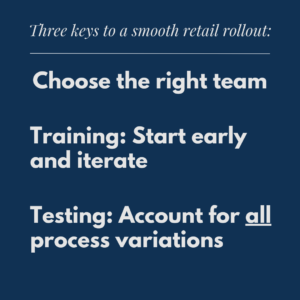
Choose the right team

Retailers will need to tap into their own teams and partner with experienced service providers to be successful. When it comes to choosing your own team, look for individuals with a strong handle on retail operations. In many instances, these can be store managers at your best stores who have seen it all. If they are to take a prominent role in designing the technology to roll-out, they need to also be a strong internal champion of the change.

Regarding partner selection, the more project complexity the more experience you will want your partner to have. Good service partners will provide you with insight into aspects of the deployment that you may not otherwise consider. They will take a lead role in planning and executing the project in a way that balances factors such as risk, timeline, and budget. A good partner will be hyper-focused on the cutover and roll out plan of the implementation as it will help result in success if done right or spectacular failure if not. Pick a partner with a real proven track record and good referenceable customers. I could write a whole blog on this topic, but hopefully you are getting the point.

Train, train, train…and train some more

The right team means very little if you neglect training. Training is too often an afterthought. The larger the technology changes, the greater emphasis training requires. Remember to start early and iterate. As decisions on process flows are made during the project, be sure to build training documents. Should you have the means, video training that is formatted in small digestible chunks is probably the best way to go. It is impossible to prevent all training related issues, but if you train frequently and well, you will position your team to avoid many headaches during roll out.

Test, test, test…and test again

Testing is such a crucial element of complex retail rollouts. Plan your timing and approach early to testing. Generally, we recommend simulating go-live at least 3 times. Test scripts cannot focus on just happy path, they need to account for all process variations. In your testing you will often need to validate connections to hardware or integrations with other 3rd party software. For example, if the POS is being replaced it will often affect the pin-pads used with associated credit card gateways and processors. Always be sure to test every credit card type (Visa, Amex, Mastercard, etc.) and payment processing variation to be sure you don’t have any money issues when rolling out to stores. Assuming you listened to the first recommendation, you will have a good team throughout this testing, but it is also important to quantify testing efforts and breadth.

As the AI era continues to innovate retail, we are going to see new and interesting opportunities worth pursuing. Should you need to roll out new technology to your stores, remember these above recommendations to get the most out of your investment. Please feel free to reach out if you would like to chat about more specifics.

Start Your Journey with Sunrise Today!

 Whether you’re exploring your options for new business platforms, or ready to get started, we are trusted business partners for some of the world’s most well-known brands. With over 25 years of experience with the Microsoft stack, we can help you understand all the capabilities Microsoft has to offer.

Transforming retail: Insights from Microsoft and Sunrise

Transforming Retail: Insights from Microsoft and Sunrise

Start Your Journey with Sunrise Today!

Whether you’re exploring your options for new business platforms, or ready to get started, we are trusted business partners for some of the world’s most well-known brands. With over 25 years of experience with the Microsoft stack, we can help you understand all the capabilities Microsoft has to offer.

An overview of the inventory visibility add-in for Dynamics 365 Supply Chain

An Overview of the Inventory Visibility Add-in for Dynamics 365 Supply Chain

Omnichannel selling has always been complex, with integrations to multiple systems and data sources making it time-consuming and expensive to get a complete picture of your inventory position. Microsoft’s Inventory Visibility Add-in for Dynamics 365 Supply Chain (also called the Inventory Visibility Service, or IVS) makes it easier to get that real-time, accurate view of inventory, even for high-volume businesses like omnichannel retailers. First introduced in 2021, the Inventory Visibility Service makes integrating multiple source systems and aggregating that data into a single view easy, fast, and flexible. Read on to learn more about the Inventory Visibility Service and get answers to common questions.

What is the Inventory Visibility Service?

The IVS is a microservice that works as an integration system that allows you to aggregate all your inventory data from different systems and use it in near real time. You can combine data from Dynamics 365 with other data sources like third-party order management systems, third-party ERP systems, Point-of-Sale systems, and WMS systems. IVS contains APIs that let you view, adjust, and soft reserve inventory. Inventory Visibility is built on Dataverse, making it easy to extend and use with Power Platform tools.

Does Inventory Visibility change the data in the connected source systems?

IVS primarily functions as a visibility service, exposing the inventory levels of all the connected data sources but without the ability to change them. However, new functionality is being added all the time. For example, Available-to-Promise (ATP) calculations for up to three months in advance were released in 10.0.32, plus the ability to create sales orders directly from soft reservations.

How does the Inventory Visibility Service work?

IVS acts as a middleman between Dynamics 365 Supply Chain, Dataverse, and any external system you want to connect. IVS does its magic through APIs and an in-memory cache. You can access it through a web interface or its data through an analytics tool like Power BI. Integrations with external systems are enabled via REST APIs, that allow you to view, and place soft reservations on inventory. Additionally, IVS allows you to define different physical measures, such as ordered, arrived, allocated, and more. IVS offers extensibility by allowing the addition of new data sources, inventory status measures, and inventory dimensions via the configuration app. The flexibility of IVS empowers organizations to adapt and accommodate changes in their data sources and inventory dimensions. IVS integrates with Dynamics 365 Supply Chain Management and periodically calls the system to retrieve updated inventory levels. The architecture eliminates the need for continuous querying of the back-end ERP system, minimizing the impact on system performance.

Soft reservations help you avoid overselling

The soft reservation concept makes performing high volumes of transactions from multiple source systems easy. Let’s look at an example: say we have an eCommerce system that’s viewing inventory in real time from IVS. When a customer adds an item to their cart, the eCommerce system places a soft reservation on that item so that it can’t be consumed by another system while the customer continues shopping. The eCommerce system gets a soft reservation ID that it will later use when it pushes the sales order to Dynamics 365. When the customer makes a purchase , D365 recognizes the soft reservation ID and converts it to a physical reservation with no worry of double inventory consumption.

Why we love IVS for omnichannel and eCommerce implementations

While IVS is powerful and useful for any organization that has inventory, we’re particularly excited about its use case for eCommerce businesses, especially high-volume eCommerce or selling across multiple sites. The Inventory Visibility Service greatly simplifies the integrations out to those sites, allowing you to manage inventory and orders in real time while removing the load from Dynamics 365 and other external systems.

The roadmap for Inventory Visibility: the future is clear

The Inventory Visibility Service acts as a powerful tool in Dynamics 365 Supply Chain Management, enabling seamless integration, expanded data sources, and near real-time inventory visibility. By leveraging IVS, organizations can enhance their inventory management capabilities, make data-driven decisions, and integrate their supply chain processes with external systems effectively. The roadmap for Inventory Visibility (and Supply Chain in general) looks exciting!

Start Your Journey with Sunrise Today!

 Whether you’re exploring your options for new business platforms, or ready to get started, we are trusted business partners for some of the world’s most well-known brands. With over 25 years of experience with the Microsoft stack, we can help you understand all the capabilities Microsoft has to offer.

Supply chain traceability and Dynamics 365

Supply chain traceability and Dynamics 365

For apparel and fashion brands striving for sustainability, knowing where to start can feel overwhelming.

Supply chain traceability is a hot topic right now. Consumers are more concerned about the environmental and social impact of the products they buy, while brands are under increasing pressure to demonstrate that their supply chains are transparent, ethical, and sustainable. Complex global supply chains, questions around who owns sustainability initiatives in an organization, and a lack of industry-wide standards make demonstrating sustainability difficult. Traceability is one way to inform more sustainable practices and help guide decision-making and technology is a powerful tool for starting your traceability journey.

At Sunrise, our experience working with apparel, fashion, and consumer goods brands has shown us just how vast and overwhelming these industries’ supply chains can be. But we’ve also uncovered small, actionable steps brands can take to start improving supply chain traceability.

What is supply chain traceability?

Supply chain traceability refers to the ability to track the journey of a product or component through every stage of its lifecycle, from raw materials to finished goods. For example, in the apparel industry, this means being able to trace the origin and environmental impact of fabrics, dyes, and other materials, as well as the conditions under which products are manufactured and transported.

Why is supply chain traceability important?

An apparel company might decide to implement traceability measures for several reasons. They might be interested in more responsible sourcing and monitoring where and who they source from. It may stem from a need to maintain compliance with certain regulatory requirements. Or ensuring product quality by applying consistent standards to finished products. Implementing better traceability helps organizations improve their ability to respond to disruptions, better manage risk, and improve the customer experience.

Case Study: Traceability project for apparel

A great example of how Dynamics 365 can enable basic supply chain traceability is through one of our customers, a global, multichannel apparel brand. The organization had a complex supply chain, selling its products in multiple countries online, in stores, and wholesale via 3PL distribution centers. As product regulations vary from country to country, product attributes need to be tracked in greater detail. For example, a jacket with the same SKU could contain materials that are eligible for sale in some countries, but not others. To add even more complexity, most of the customer’s products were seasonal, narrowing the selling window even further. These requirements meant adding additional logic to the customer’s ERP system to ensure goods that are eligible for sale in fewer countries were picked first.

Global supply chains make supply chain traceability complex.

Orchestrating the flow of goods from a manufacturer to the end customer is complicated. The parties involved in making a single t-shirt include farmers, spinners, dyers, finishers, sewists…and that’s just to make a single garment. Once it’s time to ship that t-shirt to a retailer or end customer, the packaging, transportation, and storage for said t-shirt involves a whole new group of vendors. All along the way, there are several dimensions across your supply chain that contain traceable information:

  • Raw materials: where are you sourcing your raw materials from? Do you know if fabrics like cotton or polyester adhere to industry standards?
  • Production: what do you know about the factories and production facilities that you work with?
  • Storage: Do the warehouses you use adhere to any standards regarding emissions and sustainable practices?
  • Transportation: Do your transportation options have a low carbon footprint?

At first glance, trying to track all this data seems overwhelming. The good news is that each of these areas represents a small way to get started, which could involve:

  • Tracing the origin of raw materials.
  • Evaluating the sustainability of the chemicals used to finish fabrics and dyes.
  • Identifying more sustainable packaging solutions or using recycled materials.
  • Evaluating more sustainable transportation practices.

At its most basic, implementing better supply chain traceability is about improved data quality and capture. Traceability lends itself to sustainability initiatives by creating a solid foundation of data.

By gathering data around how your products are sourced, produced, stored, and transported, you are creating a paper trail and a set of proof points for your customers. Traceability can give you a fact-based picture of your supply chain that also supports your sustainability initiatives – and your brand’s promises.

How Dynamics 365 can help you capture traceability data.

As an ERP system, Dynamics 365 is an excellent platform for managing and tracking your product data. It also integrates with existing traceability platforms. Even if you aren’t using a traceability solution or partner, the options for tracking supply chain data in Dynamics 365 can provide a goldmine of specific information you can use to back up your brand’s claims regarding product sustainability, safety, and origin.

Ways to use Dynamics 365 to support supply chain traceability

  • Dynamics 365 includes tracing features to see how an item or raw material moves through its production and sales processes.
  • Place shipping restrictions on items by transaction attributes.
  • Implement shipping restrictions to prevent products with restricted materials being sold in certain countries.
  • Use text fields for serial and lot number tracking of finished goods.
  • Attach documents to vendor master records that prove a vendor is using ethically sourced raw materials, or meets certain industry certifications, or is using recycled materials in their packaging.
  • Purchase orders can reflect that you’re using vendors that have certain industry certifications.
  • For retail sales and returns, a production order or MPO value can be captured as an information code on a retail sales order or return order to facilitate product recalls. The same thing can be done on retail inventory adjustments.
  • Adjust production BOMs to capture substitutions.
  • Record audits can be set up that regularly flag vendors or raw materials that need to be reviewed to check that they are still in compliance with your standards or outside regulations.
  • Power Platform tools like Power Apps and Power BI can make capturing, synthesizing, and distributing data across your organization easy.
  • The interconnected nature of an ERP system like Dynamics 365 means all your product data, from your purchase orders to your BOMs to your vendor information, is in one place and easily accessible.

Every organization is different. Wherever you are on your journey to building a more sustainable brand, there are options to start improving your supply chain and traceability data. While implementing supply chain traceability can be a daunting task, it’s important to remember that every small step towards sustainability counts. By starting with one area for improvement and leveraging technology solutions like Dynamics 365, brands can make meaningful progress towards their sustainability goals.

Start Your Journey with Sunrise Today!

 Whether you’re exploring your options for new business platforms, or ready to get started, we are trusted business partners for some of the world’s most well-known brands. With over 25 years of experience with the Microsoft stack, we can help you understand all the capabilities Microsoft has to offer.

Sunrise supply chain solution for Microsoft Dynamics 365

Sunrise Supply Chain Solution for Microsoft Dynamics 365

Consumer products, retail, and manufacturing companies need to be equipped to handle the complexities of a global supply chain. Sunrise has over two decades of experience solving these challenges and have extended Microsoft Dynamics 365 with exclusive inventory optimization, forecast netting, and soft allocation capabilities in a product called Sunrise 365. This solution is a favorite industry add-on for proactively managing and monitoring a healthy supply chain with gorgeous visual insights.

Learn more in the PDF below and when you’re ready, explore more about how our supply chain solution for Microsoft Dynamics 365 can transform your operations.

Intelligent apparel and footwear operations

Intelligent Apparel and Footwear Operations

Sunrise has worked extensively with apparel and footwear brands to identify the levers for improving profitability, increasing operational efficiency, and driving brand growth into new product lines, channels, and global markets. This factsheet reviews the top reasons companies choose Dynamics 365 to simplify and consolidate legacy systems with a single, global platform that will last a lifetime.

The Microsoft Dynamics AX On-Premise Legacy for Apparel and Footwear Companies


For years, Microsoft Dynamics AX set the standard for apparel and footwear brands aiming to expand globally while maintaining their promise of quality and value. Dynamics AX enabled businesses to rapidly respond to trends, scale efficiently, and manage costs effectively. The solution integrated industry best practices and business intelligence, providing a robust platform for managing supply chains and sales channels.

At its core, the agent connects supplier email communication with supply chain data. Instead of treating emails as separate from ERP transactions, it helps ensure that supplier communication reflects the current state of the system.

Why Dynamics AX Was the Best On-Premise ERP of Its Time

  • Global reach: Dynamics AX supported multi-language and multi-currency capabilities, making it ideal for international operations.
  • Multi-channel integration: It offered seamless operations across wholesale, retail, and eCommerce, ensuring a cohesive customer experience.
  • Built for Tier 1 supply chains: The platform enhanced visibility and control, optimizing inventory and improving operational efficiency.
  • Embedded business intelligence: Power BI integration allowed for data-driven decision-making, uncovering trends and insights to maximize revenue potential.
  • Value and simplicity: Combining Dynamics AX with Sunrise solutions and the Microsoft Cloud provided a cost-effective, comprehensive ERP solution.

Supporting Your Legacy Systems Today

At Sunrise Technologies, we understand the importance of maintaining and supporting legacy systems. For apparel, footwear, and fashion businesses still operating on Dynamics AX, we offer pay-as-you-go support, ensuring your system remains efficient and reliable. Our services include: 


  • Proactive Issue Management: Advanced forecasting and planning tools to spot potential issues before they materialize.
  • Optimized Operations: Simplified SKU and bill of material management to enhance reporting and operational efficiency.
  • Enhanced Decision Making: Continued support for embedded Power BI capabilities to maintain a data-driven culture. 

Transitioning to Dynamics 365

While Dynamics AX has served the industry well, the future lies with Microsoft Dynamics 365. This cloud-based solution offers enhanced security against the growing ransomware and cybersecurity concerns, more connected supply chain and reporting capabilities, and scalability to start with the core components you need. Whether you choose to optimize your existing Dynamics AX system or upgrade to Dynamics 365, Sunrise Technologies is here to support you every step of the way.

  • Seamless Upgrades: We help you transition smoothly to Dynamics 365, ensuring minimal disruption to your operations.
  • Maximize Current Investments: Leverage the full potential of your existing system with our expert support and industry best practices.
  • Future-Proof Your Business: Adopt the latest technology to stay competitive and responsive to market changes.

Contact Us for a Free Upgrade Assessment

Microsoft Dynamics AX was a pioneering solution for the apparel and footwear industry, providing unparalleled support for global operations, multi-channel sales, and data-driven decision making. Sunrise Technologies is committed to helping you make the most of your legacy systems while guiding you towards a more agile, cloud-based future. Contact us today to learn how we can support your journey.

How inventory visibility can tame retailers’ toughest pains

How Inventory Visibility Can Tame Retailers’ Toughest Pains

Start Your Journey with Sunrise Today!

Whether you’re exploring your options for new business platforms, or ready to get started, we are trusted business partners for some of the world’s most well-known brands. With over 25 years of experience with the Microsoft stack, we can help you understand all the capabilities Microsoft has to offer.

The secret sauce for a better, more connected supply chain in furniture, retail, and bedding

The Secret Sauce For A Better, More Connected Supply Chain In Furniture, Retail, And Bedding

Start Your Journey with Sunrise Today!

Whether you’re exploring your options for new business platforms, or ready to get started, we are trusted business partners for some of the world’s most well-known brands. With over 25 years of experience with the Microsoft stack, we can help you understand all the capabilities Microsoft has to offer.

The power of a connected future: Where your customer and the supply chain meet

The Power of a Connected Future: Where Your Customer and the Supply Chain Meet

What does your supply chain and customer experience have in common? Quite a bit!
The faster you can make business decisions regarding supply, production, discounts, and more, the more edge you have over your competition. But as an industry veteran, you know that is far more easier said than done.
Retail and CPG insiders understand just how complex, expensive, and risky it can be to embark on a business systems replacement project. Especially when it comes to satisfying your brand’s promise and customer satisfaction. Don’t go it alone. Check out our Connected Future eBook for insight and inspiration on how a unified cloud solution helps you achieve seamless, future-proof operations.

Start Your Journey with Sunrise Today!

Whether you’re exploring your options for new business platforms, or ready to get started, we are trusted business partners for some of the world’s most well-known brands. With over 25 years of experience with the Microsoft stack, we can help you understand all the capabilities Microsoft has to offer.

The power of a connected future: Watch our presentation from Retail TouchPoints and Retail Innovation Conference

The Power of a Connected Future: Watch Our Presentation from Retail TouchPoints’ Retail Innovation Conference

Hear from our retail expert on what it really takes to refine the customer experience

After years of being beholden to brands, the consumer is back in control. Today, people have more choice than ever before when it comes to where, when, and who they buy from. Brands who truly understand their customers will always outperform those who don’t. But excellent customer service sounds simple: provide the right products to the right customer at the right time, at a price they can afford. Yet every retail veteran knows this is easier said than done. Whether it’s planning problems, vendor woes, imbalanced inventory, or empty shelves, retailers know that the customer experience starts long before anyone steps foot into a store.

Often, we see organizations trying to address these issues in a vacuum. But the supply chain and customer experience are inextricably linked. The key to unlocking a seamless customer experience? By uniting your supply chain and customer data on a single platform. Sunrise’s retail experts are here to discuss best practices for achieving true omnichannel transformation. In this session, you’ll hear about brands that have leveraged the power of connected data — everything from buy online, pick up in-store; to turning stores into distribution centers; to consolidating legacy systems onto a single platform (and in one case, experiencing over 50% growth in digital business year over year). By investing in a single platform and scalable infrastructure, these brands have optimized their operations and are prepared for the next generation of retail

Start Your Journey with Sunrise Today!

Whether you’re exploring your options for new business platforms, or ready to get started, we are trusted business partners for some of the world’s most well-known brands. With over 25 years of experience with the Microsoft stack, we can help you understand all the capabilities Microsoft has to offer.