
9 challenges facing the furnishings industry (and how to solve them)

Furnishing Solutions That Are Just Right

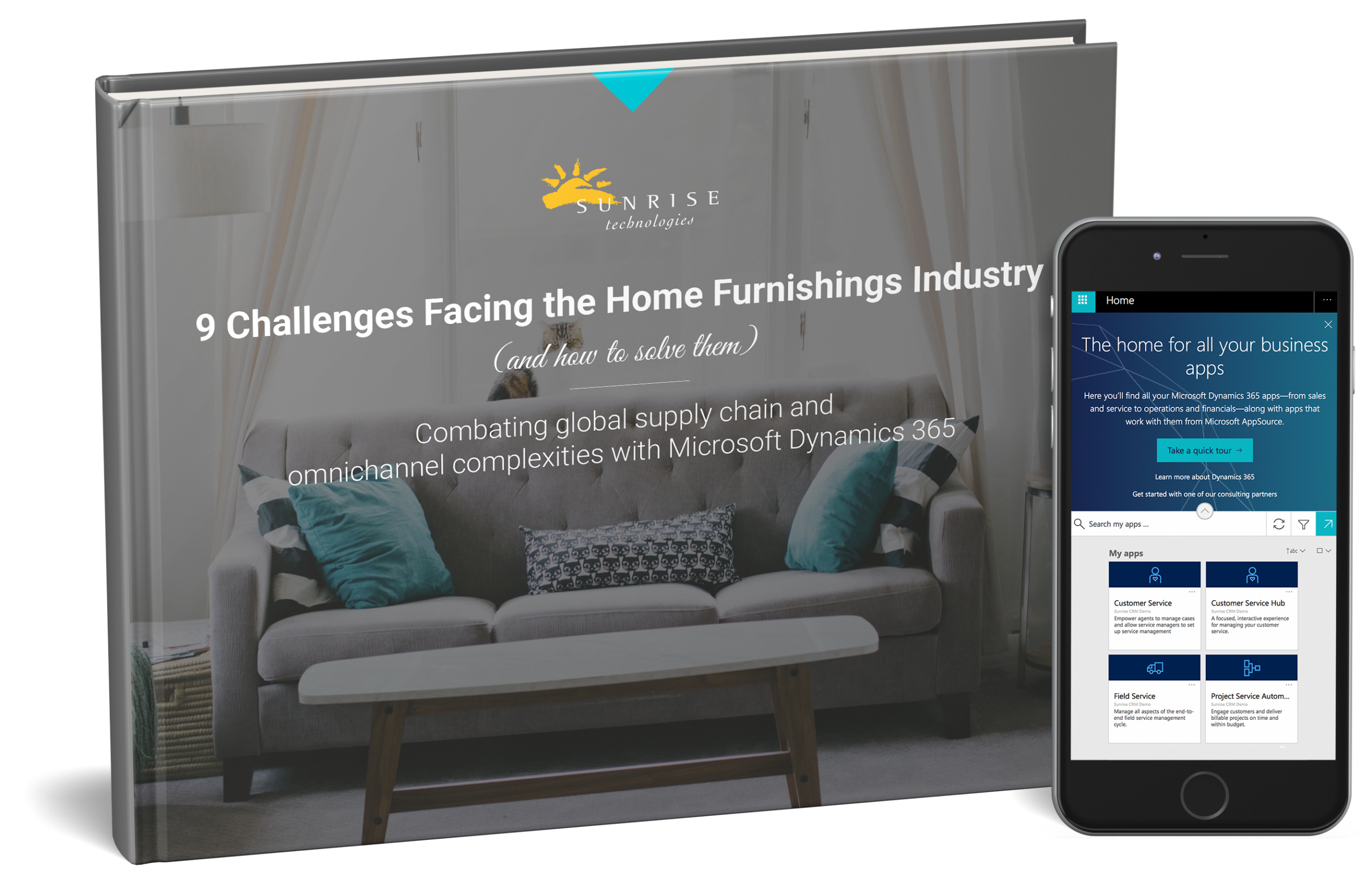
Download the ebook to get 9 actionable tips to help solve the most common problems faced in the furnishings industry. 
Don't Let Common Problems Slow You Down

Whether your furnishings business is manufacturing, distribution, retail; casegoods, upholestry, or textiles – or a mix of all of the above, there are unique challenges inherent in the industry. These are just a sample of the problems we cover in this interactive eBook.

Home Furnishings may be the definition of a multi-dimensional product and are almost always configurable. With thousands of potential combinations, you’ve got to have an intelligent management solution. 

With long lead times and a complex supply chain, there’s little room for error when forecasting demand. Intelligent allocation is a must to avoid unhappy customers and a ding to the company’s reputation. 

To grow and compete, many furnishing companies are expanding to new channels – far better for customers but can be a corporate nightmare if each channel is running in a silo. Bring them together to provide a true omnichannnel experience.

SUNRISE TECHNOLOGIES

Sunrise Technologies is a global, gold-certified Microsoft Partner specializing in the implementation and support of Dynamics 365. Sunrise also provides exclusive extensions and capabilities in key industries – apparel, footwear, consumer goods, and home furnishing companies with manufacturing, distribution, and/or retail operations.

Let us help you implement your great ideas today.

– sunrise.co –

Spotlight on: Supply chain

Spotlight On: Supply Chain

Start Your Journey with Sunrise Today!

Whether you’re exploring your options for new business platforms, or ready to get started, we are trusted business partners for some of the world’s most well-known brands. With over 25 years of experience with the Microsoft stack, we can help you understand all the capabilities Microsoft has to offer.

Private equity solutions with Microsoft Dynamics 365

Private Equity Solutions with Microsoft Dynamics 365

For private equity companies that invest in apparel, footwear, home furnishings, consumer products, manufacturing, or retail verticals, Sunrise offers a one-stop, end-to-end, global solution. Together, Microsoft’s powerful cloud technology and Sunrise’s industry solutions offer a lifetime of value.

  • Unleash portfolio growth
  • Deploy with industry best practices
  • Increase return on investment

This document explains a solution that can be deployed quickly, without all the cost and complexity.

5 reasons why our consumer brand customers choose Microsoft Dynamics 365

5 Reasons Why Our Consumer Brand Customers Choose Microsoft Dynamics 365

Our customers in apparelfootweartextileshome furnishings, and consumer goods manufacturing continue to face numerous industry challenges, especially as production becomes more decentralized and complex, and expanding global supply chains make it difficult to manage and maintain product control. While all of these issues are not going away, our customers are learning to embrace change and turn these challenges into opportunities.

One way they are doing this is by investing in ERP technology like Microsoft Dynamics 365, which is ideal for helping brands gain greater end-to-end control and the visibility with built in customer engagement (CRM) and business intelligence (BI) capabilities. This cloud solution puts the levers needed to drive greater profitability in the fingertips of users at all levels of the organization, on any device, anywhere.

Here are the top 5 reasons why our customers choose Microsoft Dynamics 365:

1. Multi-dimensional item management

With no customization required, Microsoft Dynamics 365 natively handles style, color, and size complexities. Sounds simple but anyone who has tried to fit this concept into the typical “part number” item technique of a traditional ERP solution knows this is a big deal. The system comes with item number (think style) and four additional dimensions.  This allows for multiple size scales, configuration dimensions like packaging, in addition to the standard color and size requirements.  This concept extends also to every type of item such as raw materials, roll goods, cut parts, and findings.  Each type of item can employ a different configuration of dimensions, which is exactly what this vertical needs in an ERP system. Plus, our exclusive Supply Chain 365TM extension adds transaction matrices across much of the system simplifying usability.

2. One Solution to Manage a Global Business

In today’s market, almost all consumer brand manufacturers are doing business in multiple countries and regions across the world.  Because of this, the supply chain has become much more difficult to manage while maintaining costs and customer service. One huge advantage of Microsoft Dynamics 365 is that it can support global business processes from a single cloud solution. Multiple currencies, time zones, languages, and compliance with multiple banking and reporting standards can all be managed from one solution, helping to provide consistency and standardization across various business entities around the world.

3. Unified Commerce Across Channels

Whether it’s through retail, wholesale or eCommerce, most brands today use multiple channels to sell their products. Due to this increased channel complexity, companies need to be able to manage and optimize the supply chain and inventory across these channels more effectively.   Microsoft Dynamics 365 integrates multi-channel selling directly into the ERP solution and even includes a built-in Point of Sale (POS) and eCommerce engine so our customers truly see a complete view of their customers and eliminating the channel silos of the past.  Wholesale, retail, and e-commerce live side-by-side within the application, intelligently sharing inventory, customer information, and supply chain visibility.  This concept provides a powerful platform to service the customer in an integrated manner that optimizes a company’s resources.

4. Supply Chain Visibility and Collaboration

The supply chains of brands are difficult to model.  Global in nature, with multiple levels of manufacturing required, they stress the capabilities of even the most robust ERP solutions.  Microsoft Dynamics 365 really shines by handling complex supply chains out of the box. From a sophisticated multi-site model that handles lead time variation, different vendor sourcing models, and multiple raw material suppliers, Microsoft Dynamics 365 can keep up with the demanding needs of our customers. And with our Supply Chain 365 extension, our customers also enjoy advanced forecasting, planning, allocation, execution, and analysis capabilities.

5. It works like a Microsoft product

Last but definitely not least, the product works like all of the other Microsoft products that are familiar to our customers.  This speeds up training, makes users comfortable with the system, and leverages the tools they already use in Office 365 like Excel, Word, Office, Skpye for Business, and Exchange.  In the end, this saves our customers money and insures a low total cost of ownership.

Interested in learning how Microsoft Dynamics 365 can help you? Contact our team or watch these videos to see a quick overview.

Start Your Journey with Sunrise Today!

 Whether you’re exploring your options for new business platforms, or ready to get started, we are trusted business partners for some of the world’s most well-known brands. With over 25 years of experience with the Microsoft stack, we can help you understand all the capabilities Microsoft has to offer.

Apparel / footwear industry Microsoft Dynamics 365 white paper

Apparel / Footwear Industry Microsoft Dynamics 365 White Paper

Apparel and footwear companies are under tremendous pressure to fill orders faster, reduce operating costs, and increase margins — all while expanding through acquisition or by branching out into new product lines, channels, and global markets.

Making the digital transformation to a single integrated platform is the key to gaining or maintaining a competitive advantage. And in all actuality, it’s the key to your brand’s very survival and protecting the trust and promise given to customers.

This white paper will dive further into industry challenges and explain how Microsoft Dynamics 365 combined with Sunrise 365™ industry extensions can support your brand and consolidate legacy systems, as you navigate the complexities of growth and expansion into new channels, markets, and product lines.

Start Your Journey with Sunrise Today!

Whether you’re exploring your options for new business platforms, or ready to get started, we are trusted business partners for some of the world’s most well-known brands. With over 25 years of experience with the Microsoft stack, we can help you understand all the capabilities Microsoft has to offer.

Apparel / footwear Sunrise 365 extension for Microsoft Dynamics 365 white paper

Apparel / Footwear Sunrise 365 Extension for Microsoft Dynamics 365 White Paper

This white paper will dive further into common risks of global systems deployments for the apparel and footwear industries, and explain how Sunrise 365™ industry solutions for Microsoft Dynamics 365 Enterprise edition can help improve project success and maximize time to value.

Start Your Journey with Sunrise Today!

Whether you’re exploring your options for new business platforms, or ready to get started, we are trusted business partners for some of the world’s most well-known brands. With over 25 years of experience with the Microsoft stack, we can help you understand all the capabilities Microsoft has to offer.

Business intelligence for consumer brands and retailers

Forecast netting: An art and a science

Forecast Netting

It’s an art and a science for accurate supply chain management

In day-to-day operations we focus on demand planning. We focus on supply planning. Then… we seem to lose focus. There is sometimes a sense of wishful thinking that the demand plan that was so diligently generated will magically appear in the supply plan the way we want and everything will work out perfectly!

Unfortunately, real life rarely works that way. It comes down to a fundamental difference in the ways that demand and supply plans are generated. Demand planning tends to be at a higher level—for example, at a style or style-color by week. Supply planning is at the most granular level—say, style-color-size by day. This difference in calculation is further complicated by actual orders coming in. How are they accounted for in the demand plan?

Ultimately it comes down to forecast netting. It can sometimes be tough to realize that netting logic has an impact on how the supply plan should be developed. This brings us back to the million-dollar question: is there a magic formula for how to best net demand? Short answer—not really. Some larger companies choose to run algorithms based on years of historical data, but not every company can access its data easily, or the company may be so new that folks are still figuring things out.

The right answer is depends on how aggressive or conservative your company wants to be when it comes to planning. Deciding whether to net demand at a high level then disaggregate it to lower levels, or vice versa, is an art and a science.

Just be aware that you should be prepared with a contingency plan if your actuals come in higher than your demand plan, or vice versa—but that’s a topic for another day.

Start Your Journey with Sunrise Today!

 Whether you’re exploring your options for new business platforms, or ready to get started, we are trusted business partners for some of the world’s most well-known brands. With over 25 years of experience with the Microsoft stack, we can help you understand all the capabilities Microsoft has to offer.

Evolution of the supply chain and Microsoft Dynamics AX

Evolution of the Supply Chain and Microsoft Dynamics AX

Written by Mike Pereira, Vice President at Sunrise Technologies

The Role of ERP and the Evolution of the Manufacturing Supply Chain

Manufacturing supply chains have gone through a lot of changes over the years. Having worked with Apparel and Footwear manufacturers and Furniture manufacturers for nearly two decades, we’ve witnessed these changes and how manufacturers have especially been impacted due to increased globalization and consumer demands. While the market opportunities are enormous for manufacturers today, inevitably the environment in which they operate has become more complex. As a result, companies must be agile to be able to compete in this complex supply chain environment or be left behind.

Twenty years ago manufacturing companies executed most, if not all, of the supply chain parts and components by themselves using a vertical or centralized supply chain. The manufacturer would basically be in control of the entire supply chain process from stocking raw materials to distribution. Enterprise resource planning (ERP) software was still the go-to supply chain system for many larger companies and was adequate because most of the supply chain data was stored within a single enterprise.

There was a shift in the late 1990s when U.S. manufacturers began outsourcing their operations to lower-cost suppliers across the globe. This changed the way manufacturers manage their supply chains, adding much more complexity of decisions and data from various vendors and locations. Today, supply chains continue to grow in complexity and with fluctuating global conditions; manufacturers are forced to reconsider their supply chain strategies and the technology used to manage them.

Many of the furniture and apparel manufacturers we work with today were full vertical manufacturers. For instance, apparel manufacturers would have started from yarn, potentially owning the yarn manufacturing and continuing all the way up to a finished garment, finally distributing to a customer or wholesaler. For the furniture industry, you may have started from a raw wood substrate and fabric type that culminated into a finished product of a sofa. One company would manage all of the manufacturing steps that were attached to each of those subcomponents. So the company was purchasing all of the raw materials that it took to make that product and all of the subcomponents. Not that this was simple to model, but it certainly remained under one administration for management and decision making.

Today, that supply chain network has become segregated. The purchasing has become a more complex situation. You are buying sub components of your final product; you are buying fabric, cut parts, and maybe even just buying the finished good, and adding a final attribution to the product for your customer. You are the marketing entity, you are the selling entity, you are the merchandising entity, but you are most likely not manufacturing the product.

So from an ERP system perspective, how do you model that divided supply chain? A good example would be a production order. In a traditional sense, you created a production order for your own manufacturing facility. If there were five steps in the manufacturing facility, you simply had the subcomponents that matched the five steps in your supply chain; you went to step one, you made the subcomponent, you packaged that subcomponent, sent it to step two, and continued to the finished product.

When you get into the divided supply chain, you have to accept and depend on the vendor’s ability to produce that production order, including communication to that vendor as to what that production order needs to look like. Management becomes not only a planning issue within your company, but also a management issue, understand and have visibility of that subcomponent’s production in their facility and in the supply chain.

So our customers may ask, “Do I model the vendor’s capacity and the vendor’s execution of that production order? Because in the traditional sense, it was all mine, I managed it all, and I ran it though my system, but now it’s somebody else doing the work, it’s somebody else’s manufacturing location. How much control and how much visibility do I even get to what my vendor is doing?” They may have a vendor in China, a vendor in India, and/or a vendor in Mexico, in their planning process. They must consider which vendor is the most economical to work with on this particular product during a particular time of the year, and what is the capability of that vendor to even produce that product, even if they are the least expensive option? What is their capacity? What kind of relationship do they already have with the vendor? What kind of control do I have over this subcomponent? There are many different decisions that have to be made involving vendor control and the global aspect of those decisions toward the planning process to create a complete product.

We must have a system that will allow us to handle these challenges by modeling the supply chain in the relationships that I just described, being able to handle a production and purchasing arrangement between the company and their vendors. Microsoft Dynamics AX can model very nicely the finished SKU or finished good and all of the subcomponents of the finished good. We cannot only create our internal steps or production routing, but we can also create what is called a subcontractor work order or subcontractor relationship that resides within that supply chain network. For example, my process in the U.S. as a manufacturer is to screen print on an NBA jersey, but I purchase the blank jersey from someone in China. I have an exclusive relationship with that vendor in China, by which I can model their capacity and by which I can model a production order that is going through that vendor’s facility. The issue is that in order to invoke that relationship, I am actually purchasing a service from them, as well as purchasing the product itself. So you have to have the ability to have a purchase order and a production order so that you track the execution of the production but you can also execute the purchase from that vendor, and that’s the difference in the supply chain today.

Microsoft Dynamics AX allows you to engage with that vendor by modeling a work center at the vendor location; therefore, you can model the capacity, you can model a production work order going through that capacity, and you can purchase the service which is associated to that production. Transportation logistics can be modeled from a distribution perspective as well. You can model a warehouse location at that vendor and you can model the warehouse location at the back end of your supply chain, finally connecting them with a transportation operation between. This allows full visibility to when it is produced, when it leaves the vendor’s factory, when it’s on the water, when it arrives at the port, then arriving at your distribution center where you can complete your necessary activities of the supply chain process and distribute to the customer.

Microsoft Dynamics AX truly allows you to model that global sourcing supply network, and with the multi-site/multi-location capabilities of AX, you are able to model different countries in different ways for that product. Product with varying prices across countries, varying costs and BOMs, etc… but at the end of the day it is the same finished good item.

As manufacturers become more concerned about the need for technology that is capable of working across a network of trading partners, our customers look to Microsoft Dynamics AX as their go-to ERP software of choice which plays a vital role in centralizing transaction data and managing the global supply chain.

Let’s look at some ways Microsoft Dynamics AX can help meet these challenges for Consumer Packaged Goods manufacturers.

  • Flexible Modeling to Meet Your Needs – Microsoft Dynamics AX offers flexibility through its unified models which provides a set of application concepts that reflect real-world business situations providing customers the flexibility to easily modify their organizational processes to meet their changing business needs. For instance, AX offers complete product modeling capabilities that can include the different variations of products being used within specific processes which helps prevent having to develop workarounds and invest in additional customizations to make the ERP fit in your product attributes.
  • Increase Visibility – Visibility leads to your service capability. When your vendor can update the status of the work in process, you will know when you can service that due date for that sales order. An integrated ERP solution like Microsoft Dynamics AX provides access to critical real-time information about customers, suppliers, products, processes and the data needed to make informed decisions. Whether you need up-to-date inventory levels or to check production schedules, with Microsoft Dynamics AX you get the real-time information and insight into the supply chain that you need.
  • Reduce and Control Costs – An inefficient and poorly managed supply chain can negatively impact every aspect of an organization, jeopardizing the performance of a company. With Microsoft Dynamics AX you can optimize your supply chain by centralizing data, standardizing processes, and gaining the visibility you need to optimize your business.

Manufacturers must embrace change if they want to make the improvements necessary to compete in this dynamic, increasingly complex industry. We’ve seen the companies which have successfully adapted and evolved their supply chain are now, not only the survivors in the industry, but have become the leaders in the market. While we are starting to see a shift that shows many companies’ manufacturing processes returning to the United States, and returning to a vertical manufacturing model, business will benefit from a system that is agile and powerful enough to work domestically and globally.

Start Your Journey with Sunrise Today!

 Whether you’re exploring your options for new business platforms, or ready to get started, we are trusted business partners for some of the world’s most well-known brands. With over 25 years of experience with the Microsoft stack, we can help you understand all the capabilities Microsoft has to offer.