AI for retail: How AI agents can support your frontline and HQ workers

AI Agents for retail see how AI Agents can support your store and frontline teams

In this presentation, Sunrise and Microsoft team members discuss how AI agents can help store employees get better and more consistent information around inventory, orders, pricing, and other day-to-day questions, while also automating parts of retail and customer service operations. The webinar focuses on practical uses for AI inside the Microsoft ecosystem, with examples that show how retailers can improve speed, consistency, and productivity for both store and headquarters teams.

Introducing Commerce Companion

Sunrise built Commerce Companion to support frontline retail employees with the kinds of questions that come up constantly in stores. Rather than forcing associates to search through multiple systems or interrupt coworkers for help, Commerce Companion brings together a collection of intelligent agents that can respond in natural language with information pulled from Dynamics 365 and internal knowledge sources.

The goal is straightforward: help employees get fast, accurate answers in the flow of work. Commerce Companion can answer questions like the price of an item, a customer’s purchase history, available inventory, or when the next transfer order is expected. It can also surface internal procedures and store documentation, giving employees another channel for training, onboarding, and daily decision-making.

Because Commerce Companion is built on an orchestration model, each subagent has a clear purpose and connects to the right data source for the task at hand. When deployed with Copilot Studio, it can be delivered directly in Microsoft Teams, which makes it easier for employees to access without changing how they already work.

Customer Stories: AI Agents in Action

Jaipur Living and Ordie

One Sunrise customer who is seeing success with AI Agents is Jaipur Living, a designer and distributor of hand-knotted rugs that sells across eCommerce, retail, wholesale, and B2B channels. After completing its initial Dynamics 365 Finance and Supply Chain Management project, Jaipur Living looked for new ways to build on its Microsoft investment and improve customer service operations.

The result was a sales order agent the team nicknamed Ordie. Ordie helps answer common order-related questions such as order status, tracking information, order holds, cancellations, and open amounts. Instead of relying on customer service teams to respond manually to every request, sales reps can use Ordie in Microsoft Teams to get quick answers while they are on the go or preparing for customer conversations.

According to the Jaipur Living team, one of the biggest benefits is speed. Order-status questions can take up a large share of customer service time, and Ordie gives team members direct access to real-time Dynamics 365 data from a mobile-friendly interface. The company also highlighted how quickly the solution was implemented and how easy it has been to refine based on feedback. That combination of faster answers, easier access to data, and quicker iteration is exactly what many retailers are looking for as they explore AI agents.

Licensed Sports Apparel Company

The second customer story focused on a global licensed sports apparel company that has continued to expand its Microsoft footprint as its business has grown. In this case, the organization deployed agentic solutions to support finance and accounts payable teams.

One solution was an Invoice Capture agent designed to step in when invoice processing errors occur. Instead of making AP staff investigate every issue manually, the agent interprets the error, researches the problem, gathers vendor details from Dynamics 365, and drafts outreach to request a corrected invoice. The draft can then be reviewed and refined by the AP team before it is sent.

The company also implemented a multi-agent accounts payable assistant that helps answer common vendor and invoice questions. Each subagent has a specific responsibility, and together they provide real-time responses on invoice status, pending invoices, vendor contacts, and more. One especially useful feature is a Deep Link agent that gives employees a direct URL to the relevant Dynamics 365 record, cutting down on clicks and search time.

These examples show that AI agents are not limited to customer-facing retail scenarios. They can also improve the efficiency of back-office teams by reducing manual work, speeding up routine processes, and keeping employees focused on higher-value tasks.

Recommendations for Getting Started with AI Agents

Here are four practical recommendations for organizations that want to build a stronger foundation for AI:

Build an accessible data foundation

Clean, structured, and accessible data is essential. This is often the biggest barrier to entry for organizations interested in AI. When data is well-organized and business processes are already understood inside the system, it becomes much easier to deploy agentic solutions quickly and effectively.

Identify structured, repetitive work

A good place to start is with work that happens every day, follows a predictable pattern, and creates measurable value when improved. These are the types of tasks where AI can make an immediate difference, whether than means saving time, reducing manual errors, or improving response speed.

Identify the right task types

AI is especially useful for summarizing, drafting, and reasoning over existing information. It is less suited for work that depends on rigid calculations, strict compliance logic, or hard-coded rules. In those cases, the best approach is often to keep the calculation or rules-based logic outside the AI layer, then bring the result back for the agent to interpret or explain.

Identify areas where AI can be used without causing harm

Any injection of AI into business processes must be done thoughtfully. Organizations should focus on areas where AI can support employees, reduce friction, and improve workflow without introducing risk. That starts with understanding where people lose time across their day-to-day tools and identifying opportunities to make work easier and more consistent.

Guidance for Deploying your First AI Agent

For organizations preparing to launch their first AI agent, here are four practical tips:

  1. Identify areas of opportunity: Start by looking department by department, or across cross-functional workflows, for repetitive processes with high impact. Once you find them, try to quantify the opportunity so teams can clearly understand why the use case is worth pursuing.
  2. Start small: While it’s tempting to go big with your first AI agent, it’s better to not chase a home run right away. Start with a focused use case, prove the value, gain buy-in, and expand from there. A series of smaller wins can build confidence and momentum across the organization.
  3. Learn and experiment with new tools: Retailers should stay curious and continue learning, but they do not need to rebuild everything every time a new model or tool is released. Technology partners can help guide these decisions. Once a working solution is in place, organizations can revisit and optimize it on a thoughtful cadence rather than constantly replacing it.
  4. Don’t over-solution your AI agent: An AI agent does not need to solve every scenario perfectly to be valuable. A solution that handles 80% of the work and leaves the remaining 20% for human review can still deliver meaningful results. Trying to cover every edge case from the start can slow progress and reduce adoption. The better approach is to keep the end goal in mind, focus on practical impact, and make the solution easy for employees to use in the tools they already rely on.

Get started with Commerce Companion today

Commerce Companion helps you deliver AI-powered customer service and back-office automation at the speed of today’s retail operations.


Introducing the Donated Goods Pricing App

Introducing the Donated Goods Pricing App

See how Microsoft and Sunrise help your organization deliver connected systems that work together

Nonprofit organizations are being asked to do more with limited resources, and the right technology can make a measurable difference. In this webinar, see real-world examples of how Microsoft Dynamics 365, Power Platform, AI, and analytics tools can support nonprofit retail and donation-based operations.

Highlights include a demo of the new Donated Goods Pricing App, which makes scanning and pricing donated goods fast and easy. Designed for organizations that accept donated goods for resale, such as Goodwill Industries, the custom pricing app is built using Microsoft Power Platform. It uses AI to help staff price donated items more accurately and consistently. Employees remain in full control of the final pricing decision. The webinar also demonstrates how tools like Power BI, Dynamics 365 Commerce, and Dynamics 365 Customer Insights help nonprofits gain visibility into operations, manage discounts and promotions, improve the in-store experience, and engage customers, donors, and supporters with more relevant communications.

Your nonprofit can use Microsoft technology not just to modernize systems, but to make smarter decisions, support employees, and generate more funding for the communities you serve.

Power BI

Power BI gives nonprofit leaders clear visibility into operations by turning production, pricing, and sales data into easy-to-understand dashboards. With real-time insights into employee productivity, item pricing, and sell-through performance, organizations can make decisions based on data rather than guesswork.

Dynamics 365 Commerce

Dynamics 365 Commerce helps nonprofits manage in-store sales, pricing strategies, and promotions with a flexible point-of-sale system. It supports common nonprofit retail scenarios like color-week discounts and mix-and-match promotions, while automatically applying pricing rules to reduce errors and speed up checkout.

Dynamics 365 Customer Insights

Dynamics 365 Customer Insights brings together customer, donor, and supporter data to enable more personalized and timely communication. Nonprofits can create automated journeys for welcoming new shoppers, promoting store openings, or engaging donors and volunteers, with Copilot assisting in drafting on-brand messaging.

“We’re not looking to replace employees. We’re focused on giving them better tools to do their jobs and helping nonprofits get the most out of their inventory to support their mission.”

Carlos McDonald, Senior Business Application Sales Executive, Microsoft

Streamline donated goods pricing with Microsoft’s AI-powered app

Streamline Donated Goods Pricing with Microsoft’s AI-Powered App

Get donated goods on the sales floor faster. The Clothing Pricing App uses Power Platform and AI to help people quickly scan and price donated clothing. Developed by Microsoft with Sunrise specifically for nonprofits and organizations that resell donated items, the Clothing Pricing App is easy to install and integrate into your existing tech stack. From quick setup and training to full system integration with donation and retail systems, our Bronze, Silver, and Gold packages offer scalable options that fit your needs and budget—so you can stay focused on your mission.

Start Your Journey with Sunrise Today!

Whether you’re exploring your options for new business platforms, or ready to get started, we are trusted business partners for some of the world’s most well-known brands. With over 25 years of experience with the Microsoft stack, we can help you understand all the capabilities Microsoft has to offer.

Retail technology rollout: Three keys to succeed

Retail technology rollout: Three keys to succeed

Scott Higley, Sr. Solutions Manager

Retailers face a spectrum of complexity when rolling out new technology to their stores. Deploying a new tech can seem relatively simple at first, but when multiplying the effort to hundreds of locations and thousands of employees, it inevitably gets harder. Furthermore, the closer the new tech is to the customer experience and order processing, the more difficult the rollout.

Often the most complex tech to implement are POS applications and connected hardware. These could be deployed to lanes or cash wraps in the form of fixed terminals or remain more mobile with tablets. For retailers, these projects entail large capital investment and are generally aimed at unifying commerce, differentiating the customer experience, and cloud modernization for greater security.

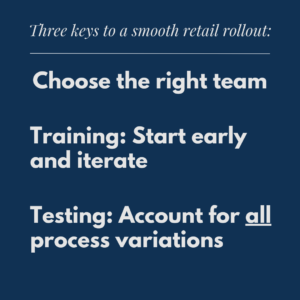
Based on my experience overseeing retail deployments in numerous stores, here are three key recommendations for ensuring a successful rollout:

Choose the right team

Retailers will need to tap into their own teams and partner with experienced service providers to be successful. When it comes to choosing your own team, look for individuals with a strong handle on retail operations. In many instances, these can be store managers at your best stores who have seen it all. If they are to take a prominent role in designing the technology to roll-out, they need to also be a strong internal champion of the change.

Regarding partner selection, the more project complexity the more experience you will want your partner to have. Good service partners will provide you with insight into aspects of the deployment that you may not otherwise consider. They will take a lead role in planning and executing the project in a way that balances factors such as risk, timeline, and budget. A good partner will be hyper-focused on the cutover and roll out plan of the implementation as it will help result in success if done right or spectacular failure if not. Pick a partner with a real proven track record and good referenceable customers. I could write a whole blog on this topic, but hopefully you are getting the point.

Train, train, train…and train some more

The right team means very little if you neglect training. Training is too often an afterthought. The larger the technology changes, the greater emphasis training requires. Remember to start early and iterate. As decisions on process flows are made during the project, be sure to build training documents. Should you have the means, video training that is formatted in small digestible chunks is probably the best way to go. It is impossible to prevent all training related issues, but if you train frequently and well, you will position your team to avoid many headaches during roll out.

Test, test, test…and test again

Testing is such a crucial element of complex retail rollouts. Plan your timing and approach early to testing. Generally, we recommend simulating go-live at least 3 times. Test scripts cannot focus on just happy path, they need to account for all process variations. In your testing you will often need to validate connections to hardware or integrations with other 3rd party software. For example, if the POS is being replaced it will often affect the pin-pads used with associated credit card gateways and processors. Always be sure to test every credit card type (Visa, Amex, Mastercard, etc.) and payment processing variation to be sure you don’t have any money issues when rolling out to stores. Assuming you listened to the first recommendation, you will have a good team throughout this testing, but it is also important to quantify testing efforts and breadth.

As the AI era continues to innovate retail, we are going to see new and interesting opportunities worth pursuing. Should you need to roll out new technology to your stores, remember these above recommendations to get the most out of your investment. Please feel free to reach out if you would like to chat about more specifics.

Start Your Journey with Sunrise Today!

 Whether you’re exploring your options for new business platforms, or ready to get started, we are trusted business partners for some of the world’s most well-known brands. With over 25 years of experience with the Microsoft stack, we can help you understand all the capabilities Microsoft has to offer.

Empowering retail employees: Three essential tools

Empowering retail employees

Does your team have these essential retail capabilities?

Cameron Caudill, Solutions Manager at Sunrise Technologies

Throughout my childhood I recall being taken to the shoe store once per year to get a new pair of shoes before school started. I (like most boys in elementary school) did not look forward to this trip. I have memories of sitting on the bench, trying on various pairs of shoes, and having a young sales associate walk back and forth from the sales floor to the back room to check stock and assist the selling process.

These memories resurfaced when I went to pick out a new pair of running shoes a few weeks ago.  I had to laugh at how different the buying process had become. A sales associate was able to scan items, obtain product information, and check stock without leaving my side. In the age of instant information in the hands of every consumer, retail employees must be equipped with tools to provide the best customer experience.

When I break it down further, the technology retail employees leverage must be fast, reliable, and accurate:

Retail technology should be fast

Capitalizing on having the customer in the store to make a purchase is crucial. Fast has different meanings depending on the context (and customer), but in a retail store an associate must be able to provide the customer with an answer without making the customer question what is going on. In today’s immediate economy, if the store associate wavers too long on the answer the customer may begin researching alternate stores and options from within the store!

Connectivity should be reliable

Internet access should never be the difference between making or losing a sale. I have been in many retail stores and worked with retail organizations that have stores in remote locations or have internet connectivity issues in areas of the store. The technology that retail employees utilize must be reliable. If the internet connection drops, an associate should still be able to help customers with the device in their hand.

Product, inventory and shipping information should be accurate

The importance of accurate information should never be understated. Knowing the location of an item within the store, the quantity on hand, or when the next shipment will arrive is an absolute must-have in today’s marketplace. The information provided to the customer must be accurate to meet the customer’s expectations.

Focus on what makes your brand special

Not all organizations operate the same way, and all organizations have something that makes them unique. However, retail organizations must empower their employees to drive customer satisfaction (and sales) in stores. At Sunrise we love helping our customers implement great ideas. I love helping organizations find solutions to their business problems. Please reach out with any questions—I look forward to chatting with you soon!

Ready to improve your customer experience?

Schedule a call with our experts today.

Transforming retail: Insights from Microsoft and Sunrise

Transforming Retail: Insights from Microsoft and Sunrise

Start Your Journey with Sunrise Today!

Whether you’re exploring your options for new business platforms, or ready to get started, we are trusted business partners for some of the world’s most well-known brands. With over 25 years of experience with the Microsoft stack, we can help you understand all the capabilities Microsoft has to offer.

Unleashing the power of AI in retail: Read the report from Retail Cloud Alliance

Unleashing the Power of AI in Retail: Read the report from Retail Cloud Alliance

Discover how artificial intelligence (AI) is reshaping the future of retail. In this insightful report, delve into the transformative impact of AI on every aspect of retail operations:

  • AI is poised to revolutionize customer personalization by generating vast amounts of customer data and providing personalized recommendations
  • AI enables retailers to extract valuable insights, provide guidance, and automate decisions, enhancing the potential of new data
  • The strategic implementation of AI services is becoming crucial for businesses seeking a competitive edge in the era of digitization and data-driven analysis
  • AI optimizes inventory management, markdown strategies, and price optimization, leading to more competitive retail operations
  • AI can personalize training by analyzing employee performance and adapting materials to meet individual needs
  • AI also plays a role in fraud prevention, utilizing historical data to identify anomalies and patterns associated with repeat offenders

For a deeper dive, download the full report below.

Sunrise and Microsoft are proud to support the Retail Cloud Alliance. The Retail Cloud Alliance helps organizations reimagine retail in by bringing together retail industry leaders, focus groups, and subject matter experts for insights into how retailers can thrive in today’s environment.

Start Your Journey with Sunrise Today!

Whether you’re exploring your options for new business platforms, or ready to get started, we are trusted business partners for some of the world’s most well-known brands. With over 25 years of experience with the Microsoft stack, we can help you understand all the capabilities Microsoft has to offer.

Elevating the shopping experience: How analytics and intelligent store capabilities drive retail innovation

Elevating the Shopping Experience: How Analytics and Intelligent Store Capabilities Drive Retail Innovation

Retail has always been a data-driven business, and data has never been more vital to understanding and improving your customer experience. Discover the transformative power of cutting-edge technologies and innovative strategies that redefine the way your customers shop. Modern data analytics platforms can help you improve processes and provide insights into everything, from inventory planning to customer behavior. In addition to analytics, computer vision and other AI-assisted technologies are turning the customer experience into one that engages them at every turn…but are your systems prepared to deliver such a comprehensive experience?

Enjoy this eBook from IDC and Microsoft, featuring insights from their retail and consumer goods analysts on where brands and retailers are focusing their investments for innovation and digital transformation.

Take steps or get left behind. It may be hard to know where to get started, but the dangers of doing nothing are worse. Retailers must invest in back-end analytics to derive value from all other digital transformation efforts.

— IDC, “Frictionless Customer Journeys: Elevating the Shopping Experience in the Intelligent Store”

Start Your Journey with Sunrise Today!

Whether you’re exploring your options for new business platforms, or ready to get started, we are trusted business partners for some of the world’s most well-known brands. With over 25 years of experience with the Microsoft stack, we can help you understand all the capabilities Microsoft has to offer.

The future of furniture: Are your systems connected and ready?

The future of furniture is connected

To take your furniture operations to the next level, look at these 5 key areas

The future of furniture is connected: are your systems ready?

The shopping experience is collapsing into a single channel: the customer. Today people expect a seamless shopping experience whether it begins online, in store, or a mix of both, plus attentive customer service that’s available whenever they need help.

The furnishings industry is no exception. Orchestrating the business processes for furniture manufacturing, distribution, and retail is notoriously difficult. Cloud-based ERP platforms like Dynamics 365 make it possible to integrate all of your business systems and create a seamless operational experience. With nearly 30 years of experience as an ERP implementor and systems integrator, we’ve helped our customers work through some of their trickiest friction points across their supply chains, production processes, and customer service.

We like to say that the future of furniture is connected. We have observed a few recurring pain points in the following areas — and helped our customers identify opportunities for improvement:

Configuration and embellishments | Shipping and logistics | Data and insights | Quality control and field installation | Siloed business systems

Configuration and embellishments

“Give the customer what they want!” Sounds simple enough, right? But every furniture industry veteran knows that giving the customer what they want is easier said than done. Coordinating custom orders across multiple systems and teams can lead to logistical nightmares, delays, and even costly errors.

The key to streamlining custom orders is to work smarter, not harder. Decrease manual workloads around customer orders by capturing configuration details upfront in your business systems and pass them along to every step of production that might have highly stylized processes. Capturing these details and passing them along can include automated notifications and reminders to ensure everyone involved in the production process is aware of the customization requirements.

Shipping and logistics

One of the most complicated moving pieces for furniture retailers, manufacturers, and distributors is, well, moving pieces!

Shipping furniture is a complicated affair, especially when it comes to items that are meant to go together. A dining table and chairs, for example. Or a bedroom set. But with multiple products, shipping destinations, and customer preferences, keeping inventory flowing while making sure customers receive all the pieces from their orders quickly can get overwhelming.

Many organizations rely on the knowledge of their long-time employees to define shipping processes and rules for sets of items. However, relying solely on this institutional knowledge is not sustainable, particularly if there are plans to expand your product catalog. It is crucial to provide clear instructions and guidelines to everyone involved in the shipping process. Partnering with the right experts can help define these rules within your business systems.

Data and insights

Even without the challenges of the past few years, managing furniture supply chains has always been difficult. We like to say that brands don’t compete – their supply chains do. Changes in terms, tariffs, and freight charges can have a significant impact on pricing and profitability. To stay competitive, you need to be able to quickly estimate costs and adjust your pricing and cost strategies accordingly. Taking it one step further, being able to project future costs saves you time and makes your organization more efficient overall. Your ability to quickly pivot could be the difference between you and your next closest competitor.

You should have a solution that can drill deep down into the actual costs for your products and see the cost broken out by physical dimensions, like weight or volume, and see how these different dimensions affect your freight bills. Such a level of detail makes it possible to quickly adapt – for example, say you discover a large, bulky item is so heavy it’s adding on undue cost. You could work with the manufacturer to find a lighter weight version to increase that item’s profitability

Ultimately, the key to success in managing your supply chain is data. Every input to your supply chain is producing data, but if you don’t have a solution for ingesting all your forecasts, lead time analysis, vendor scorecards, production capacities and turning it all into actionable advice, it’s doing you about as much good as a two-legged stool.

Quality control and field installation

Everyone from your sales team to your field service technicians to your finance team has a stake in quality control. Customers today have more choices than ever before, and they aren’t shy about sharing their experiences when something goes wrong. Returns and rejected deliveries cost time, money, and sometimes your company’s reputation.

First and foremost, you need to ensure that your current system can automatically track goods from production to delivery. The ability to quickly identify all inventory pieces that may be affected by a quality issue is crucial for delivering a great customer experience.

Second, your delivery process should meet customer expectations. Furniture retailers who also distribute have the unenviable task of having to manage large, complicated, expensive deliveries. No one is going to applaud that you got them their dining room table and chairs without any dings or dents – they just expect it. But we know how challenging it can be and it leads us to our third point…

Do you know your weak links? If you’re getting consistent feedback that the quality of a product is not up to standard, or you’re seeing repeated deliveries rejected, are you able to quickly determine where things have gone wrong? Is it something during manufacturing? The warehouse? Or maybe it’s a bad delivery service. Your ability to quickly parse this data and identify the weak link is key to nipping this problem in the bud.

Siloed business systems

A common theme we’ve noticed among many of the furniture brands we’ve dealt with is once they find a business system that works for them, they tend to stay with it. And stay. And stay…

Brand loyalty is a great thing. However, the reluctance to let go of legacy systems opens up your organization up to vulnerabilities like ransomware, falling behind due to manual processes, and maintaining expensive, dual-sided integrations.

For example, manual processes just can’t keep up when the rest of the world is moving digitally. And while having long-tenured employees speaks volumes about your corporate culture, relying on their institutional knowledge to manage your processes is a recipe for trouble. What happens when they retire or decide to move to a new opportunity?

What’s the solution?

If you’ve identified with any of the above issues, we have good news! They are all solvable. A cloud-based business system makes all the data you’re already gathering work for you, not against you. As we already discussed, your customers expect constant visibility into their order status – shouldn’t you and your team expect the same from your business systems?

If you’re interested in how Dynamics 365 can work for the furniture industry, you can learn more here.

Ready to learn more?

Schedule a call with one of our industry experts today. We work with furniture brands, retailers, manufacturers, and distributors to streamline and modernize their operations on a single platform — Dynamics 365.

How inventory visibility can tame retailers’ toughest pains

How Inventory Visibility Can Tame Retailers’ Toughest Pains

Start Your Journey with Sunrise Today!

Whether you’re exploring your options for new business platforms, or ready to get started, we are trusted business partners for some of the world’s most well-known brands. With over 25 years of experience with the Microsoft stack, we can help you understand all the capabilities Microsoft has to offer.