The ERP Value Matrix reflects the continued shift to the cloud, with vendors seeing accelerated adoption rates. Microsoft continues in its Leader position with Microsoft Dynamics 365 for Finance and Supply Chain, Enterprise Edition. All the enterprise capabilities in Microsoft Dynamics for Finance and Supply Chain, Enterprise edition are underpinned by Microsoft’s global delivery strategy that includes 36 geographies and over 60 language localizations. Additionally, the Microsoft business application platform delivers capabilities such as Power Apps, Power BI, Power Automate, and the Microsoft Dataverse (formerly Common Data Service), helping customers better collect and analyze their data as well as build applications to automate manual tasks.
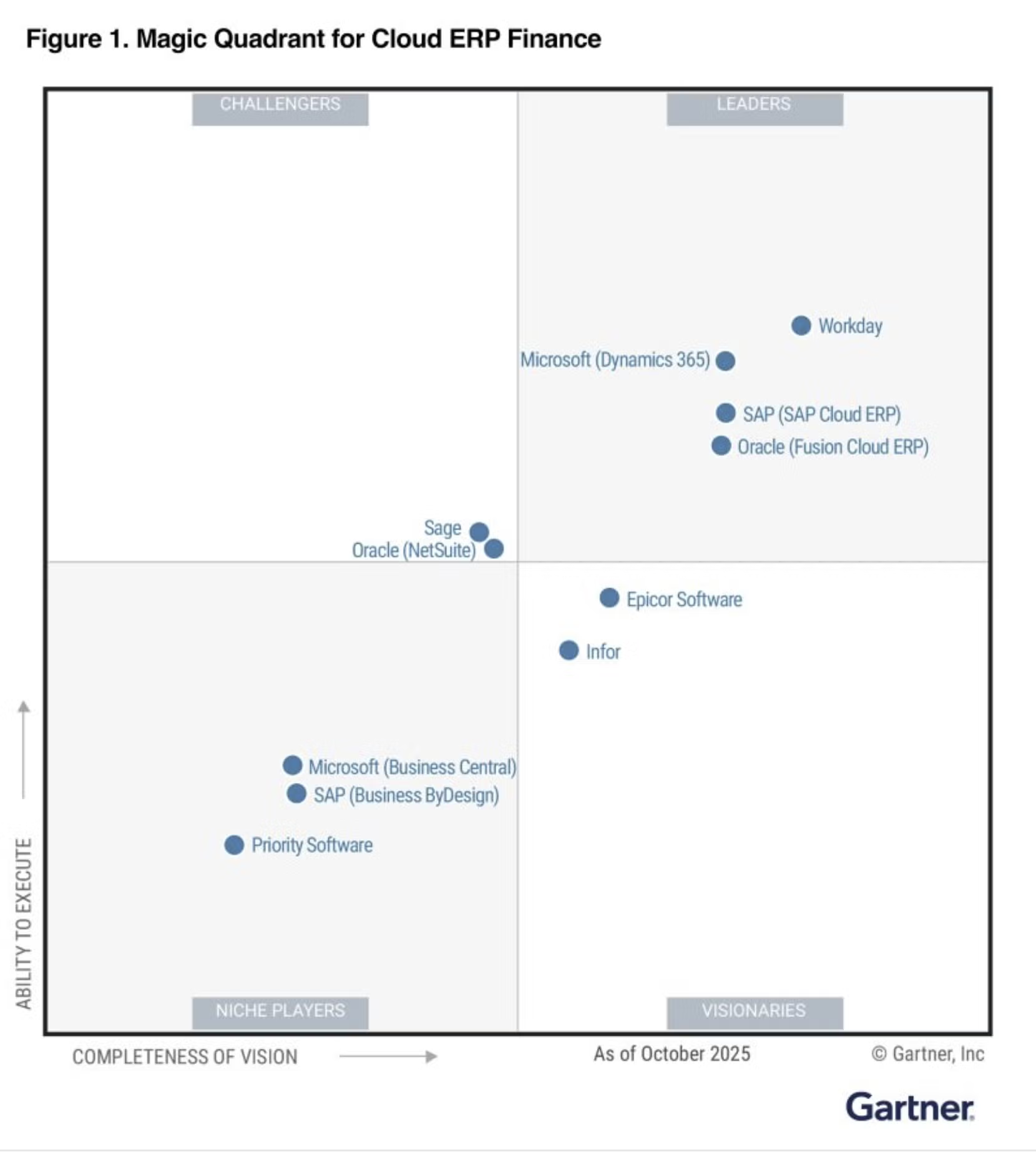
Microsoft, A Leader in the Magic Quadrant for Cloud ERP
Product-centric organizations are increasingly adopting cloud ERP platforms to standardize operations and drive intelligent automation. The 2025 Gartner® Magic Quadrant™ recognizes Microsoft as a Leader for its ongoing innovation and proven ability to support scalable, composable transformation across finance and operations.
The Total Economic Impact™ of Microsoft Dynamics Supply Chain
Microsoft Dynamics 365 Supply Chain Management addresses key supply chain challenges. These include limited visibility, adapting to changing customer demands, outdated systems, and disruptions. The solution enhances visibility across the supply chain network, enabling better planning, agility, and asset uptime optimization, ensuring smooth operations even during disruptions. Forrester Consulting conducted a Total Economic Impact™ (TEI) study to assess the potential ROI of deploying Dynamics 365 Supply Chain Management. The investment led to significant benefits, including:
Increased production volume capacity by 10% to 15% due to faster time-to-market.
Enhanced operational efficiency with a 2% to 3% reduction in unplanned machine downtime, worth over $1.5 million over three years and 500 manufacturing machines.
Increased developer productivity by 10% to 50%, reallocating developer time for higher-value tasks.
A 5% boost in revenue attributed to improved product quality, translating to more than $6.8 million in three years.
Infrastructure footprint consolidation of 35% to 65% by shifting from on-premises to cloud solutions, saving close to $11 million over three years.
The Total Economic Impact™ of Microsoft Dynamics Finance
Microsoft commissioned Forrester Consulting to conduct a Total Economic Impact™ (TEI) study and examine the potential return on investment (ROI) enterprises may realize by deploying Microsoft Dynamics 365 Finance. The purpose of this study is to provide readers with a framework to evaluate the potential financial impact of Dynamics 365 Finance on their organizations.
To better understand the benefits, costs, and risks associated with this investment, Forrester interviewed four representatives with experience using Dynamics 365 Finance. For the purposes of this study, Forrester aggregated the interviewees’ experiences and combined the results into a single composite organization that is a retail and wholesale organization with 120 finance personnel and revenue of $750 million per year.
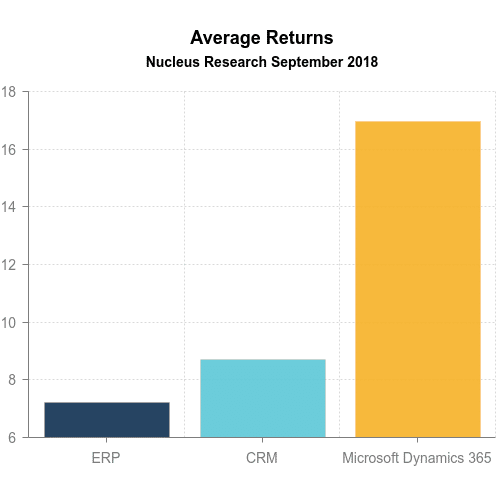
In analyzing the results of Microsoft Dynamics 365 deployments, Nucleus found that for every dollar spent, companies realized an average of $16.97 in returns. This is significantly higher than the average for both enterprise resource planning (ERP) and customer relationship management (CRM), which deliver, on average, $7.23 and $8.71 respectively. Nucleus found that companies taking advantage of Microsoft’s investments in cloud and usability, as well as integration and analytics, were able to achieve significant returns by increasing productivity and revenues and reducing costs. Microsoft’s integration of business capabilities such as ERP, CRM, and HCM with Office 365, Power BI, Power Platform, and Azure offer even greater value than the industry averages and as Microsoft makes further investments in integration and innovation, customers will benefit from the additional value provided by the cloud platform.
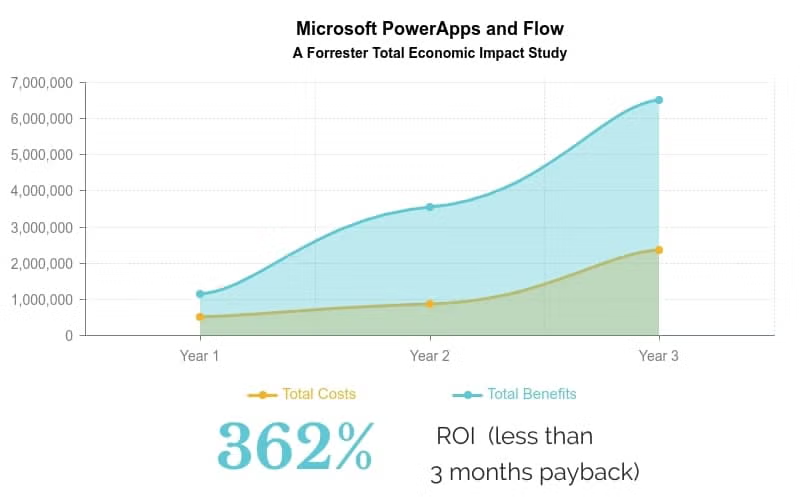
Adopting Power Apps can transform a company’s IT function from a blocker to an enabler. One interviewee in the Forrester Total Economic Impact Study said: “We can now build once and deploy to different places….We can now make changes on the fly and support a very dynamic business.” Benefits included:
74 percent less cost to develop an application
188 percent ROI over 3 years, with a net present value of $6.1 million
A staggering seventy-six percent of retail and CPG decision-makers agree that improving digital commerce capabilities is their most urgent business priority. And yet for many organizations running on legacy or disparate systems, this goal is far out of reach. Microsoft commissioned Forrester to evaluate how retail and CPG companies are approaching digital commerce improvements today. In this thought leadership report, read key insights about the state of the retail and CPG industries in a post-pandemic world, and how technology leaders plan to invest to make true unified commerce a reality.
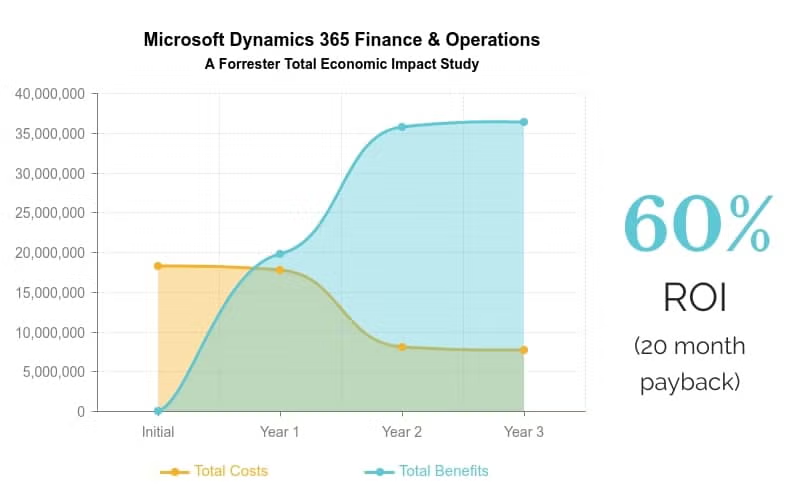
The Total Economic Impact™ Of Microsoft Dynamics 365 For Finance And Operations
Cloud simplicity, gained agility, improved user adoption, and enhanced security were a few of the benefits of Microsoft Dynamics 365 Finance and Operations. The quantitative benefits over a three year period included:
Increased wholesale revenue by 3 percent, retail revenue by 4 percent and decreased excess inventory and shrinkage by 10 percent
Operational efficiencies reduced cost of goods sold by 10 percent and improved gross margin by 2.4 percent
Employee productivity gains reduced shop floor staffing by 6 percent, increased finance productive by 20 percent, and increased sales productivity by 4 percent
Total benefits resulted in a 60 percent ROI and a 20 month payback period, including legacy license, maintenance, hardware, and admin cost avoidance
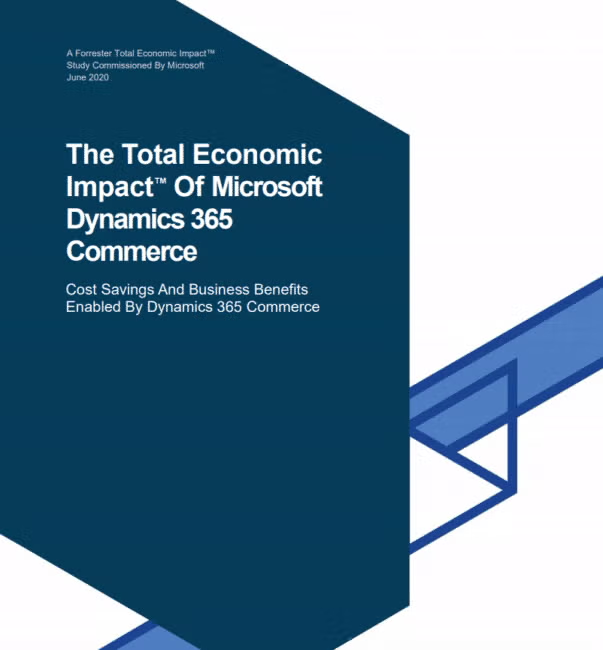
The Total Economic Impact™ of Microsoft Dynamics Commerce
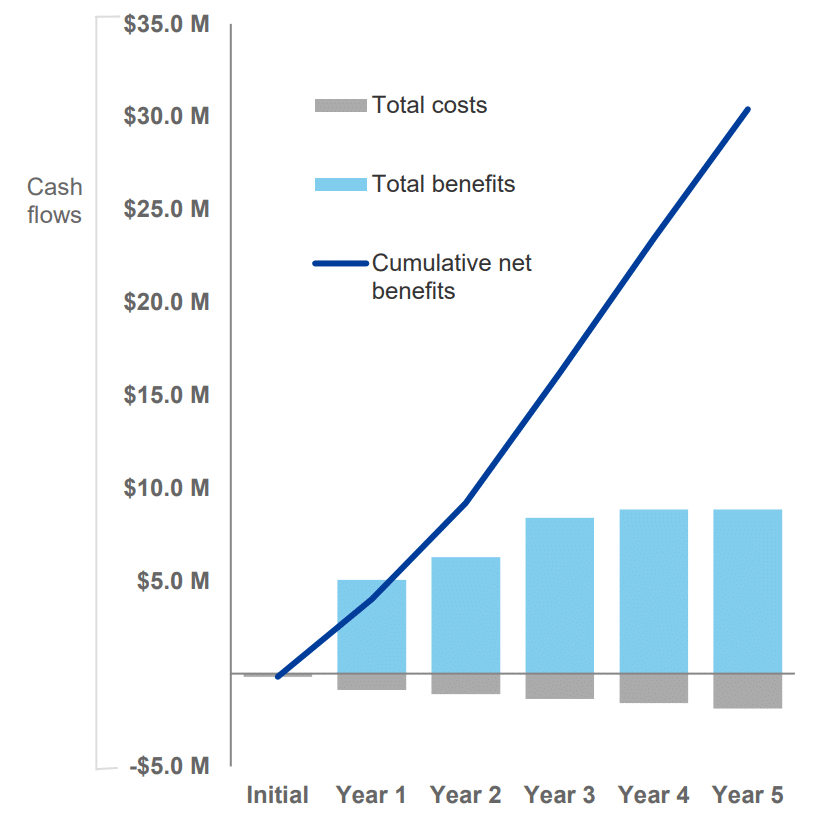
Dynamics 365 Commerce provides a seamless shopping experience across physical and digital channels. Customers using a network of disparate and inflexible legacy solutions stand to save significant time and money by moving to an integrated omni-channel solution like Commerce. Forrester’s Total Economic Impact study of Dynamics 365 Commerce found:
Improved inventory management to the tune of $3.7 million
Saved $1.9 million through decreased training time
Gartner has named Microsoft Security a Leader in five Magic Quadrants. This is exciting news that we believe speaks to the breadth and depth of our security offerings. Microsoft was identified as a Leader in the following five security areas:
The Total Economic Impact™ Of Microsoft Azure IaaS
Microsoft commissioned Forrester Consulting to conduct a study to examine the potential return on investment (ROI) enterprises may realize by shifting some or all their management and operations from on-premises, hosted, and outsourced implementations to Azure’s infrastructure-as-a-service (IaaS) offering. Benefits included:
Improved production efficiency
Reduced datacenter, IT resource, and outsourcing costs
Easier and faster software and hardware management (such as patching and support)
A Platform for Today, Tomorrow, and Decades from Now
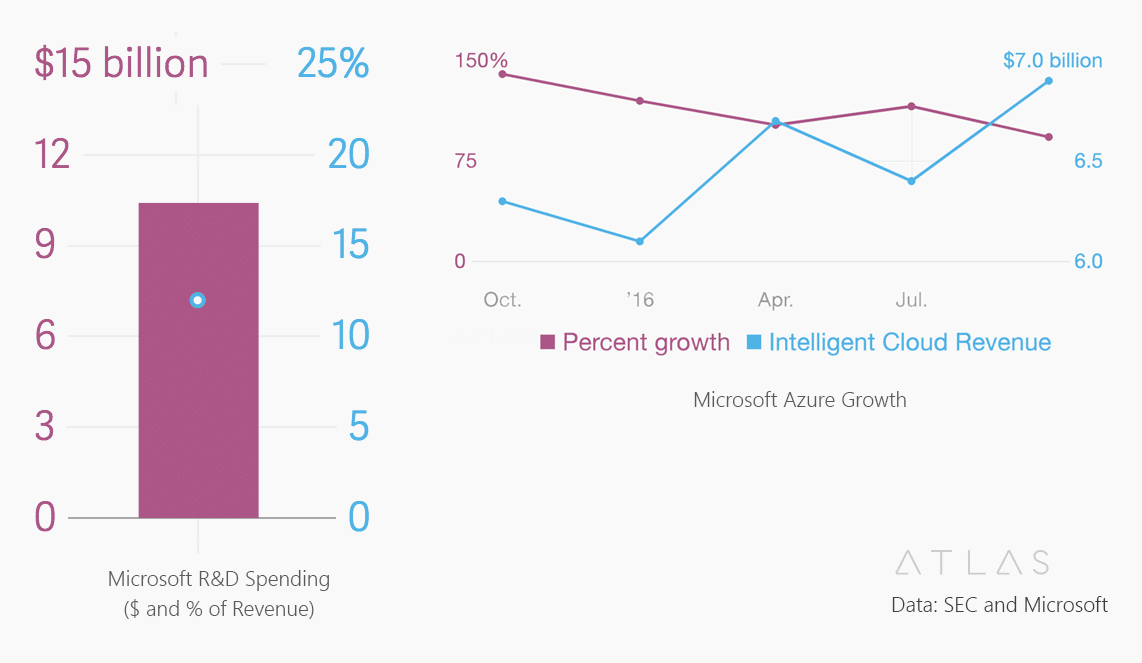
Microsoft offers a complete platform at a tremendous value. When you consider the billions of dollars invested in research and development, cloud growth, and long term viability, an investment in Microsoft makes long term sense.
Ready to learn more about what Dynamics 365 can do for your business?